Shopping for a swing set when your child is one, two, or three years old feels deceptively simple — until you start reading the fine print. Suddenly you’re staring at certification acronyms (ASTM, CPSC, IPEMA — more on all of those below), wondering whether a standard “belt swing” is even safe for a child who can’t yet grip independently, and doing mental math on whether the set you buy today will still fit a five-year-old. This guide cuts through all of that. We’ll explain what the safety standards actually require for this specific age band, why the bucket seat — the deep, high-backed swing seat that wraps around a toddler’s hips and thighs — is non-negotiable for under-threes, and how to think clearly about the growth-path problem: the fact that a toddler-optimized set can feel obsolete in 18 months if you don’t plan ahead.
Whether you’re a parent budgeting $500–$2,000 for a backyard set or a daycare procurement manager sourcing for a licensed facility, the decision framework is the same. The stakes are identical too: toddler falls are among the leading causes of emergency-room visits for children under five, per the CDC’s playground injuries fact sheet.
| EDITOR'S PICK[FUNLIO 2 in 1 Swing Set for Tod…](https://www.amazon.com/dp/B09WMN9XRX?tag=greenflower20-20) | Mid-tier[FUNLIO Toddler Swing with Folda…](https://www.amazon.com/dp/B0DPYZJ9T4?tag=greenflower20-20) | Budget pick[Sportspower My 1st Toddler Swin…](https://www.amazon.com/dp/B01ENX08OM?tag=greenflower20-20) | |
|---|---|---|---|
| Type | Swing & Jumper | Swing only | Swing only |
| Min age | — | 1 year | — |
| Max age | — | 10 years | — |
| Safety harness | — | — | ✓ |
| Sandbags incl. | ✓ | ✓ | — |
| Foldable stand | ✓ | ✓ | — |
| Price | $119.99 | $84.99 | $55.86 |
| See on Amazon → | See on Amazon → | See on Amazon → |
Why the 1–3 Age Band Has Its Own Safety Standard (and What That Means for You)
Most parents are vaguely aware that playground equipment carries safety ratings, but few know there are separate ASTM standards for toddlers versus older children. Here’s the shorthand:
- ASTM F1148 covers home playground equipment for children ages 2–10. It sets rules on fall zones, entrapment openings, and hardware.
- ASTM F2373 is the one you care about for this age group. It covers infant and toddler playground equipment — specifically products intended for children under 5, with special provisions for the 1–3 window. Requirements include tighter entrapment-gap limits (so small fingers and necks can’t get caught), mandatory enclosure or containment for elevated platforms, and specific load ratings for bucket seats.
- CPSC Handbook Publication 325 (the agency’s Public Playground Safety Handbook) provides the enforcement-adjacent guidance that states and municipalities use to inspect facilities. Even for residential buyers, it’s the best plain-English translation of what “safe” actually looks like in practice.
- IPEMA (International Play Equipment Manufacturers Association) offers third-party certification that a manufacturer’s product has been independently audited against ASTM and CPSC standards — not just self-declared compliant. For daycare and school buyers, IPEMA certification is often required by state licensing rules.
The practical implication: when a product listing says “meets ASTM standards,” ask which ASTM standard. A set compliant with F1148 but not F2373 may be fine for a four-year-old and genuinely unsafe for an 18-month-old. Per ASTM International’s published scope document for F2373, the standard specifically addresses “containment, fall height, and entrapment for children who have not yet developed reliable balance and grip strength.” That phrase — reliable balance and grip strength — is the engineering translation of “your toddler.”
By the numbers:
- ASTM F2373 caps permissible entrapment openings at 3.5 inches (too small for a head) or 9 inches or greater (large enough that a head passes through freely) — nothing in between
- Recommended fall zone clearance for toddler equipment: 6 feet in all directions from the structure’s perimeter, per CPSC Publication 325
- Maximum platform height for unsupervised toddler access (ages 1–3): 32 inches under F2373 guidelines
- Bucket seat weight ratings from major manufacturers typically span 15–50 lbs, covering approximately ages 6 months–3 years
Bucket Seats: The Non-Negotiable, and the Upgrade Cliff
The bucket seat — sometimes called a “tot seat” or “infant seat” in product listings — is the deep, molded plastic or rubber seat that cradles a toddler’s torso and keeps them from pitching forward or sliding out. A flat belt swing, the kind you probably grew up with, offers zero containment for a child who hasn’t yet developed the core strength and grip to hold themselves upright under swing momentum.
For children under 24 months, look for a full-bucket design with a T-bar or front bar that locks across the child’s lap. For ages 2–3, a standard bucket without a bar is generally sufficient, but check the manufacturer’s stated weight floor as well as ceiling — some budget buckets start feeling loose and undersize around 35 lbs, which some two-year-olds will hit.
What to look for in the spec sheet:
- Chain vs. rope: Galvanized or powder-coated steel chain is the industry standard for residential bucket swings. Rope looks charming but degrades faster in UV and moisture. Penn State Extension’s outdoor play environments guidance specifically notes that natural-fiber rope requires seasonal inspection and replacement on shorter cycles than metal chain.
- Seat material: High-density polyethylene (HDPE) or rubberized plastic holds up better than thin injection-molded plastic under years of UV exposure. Owners of daycare-grade equipment consistently report that HDPE seats retain their structural integrity well past five years of daily use; budget plastic seats commonly show cracking at the chain attachment points in 18–24 months.
- Attachment hardware: Look for closed S-hooks (fully closed, not open-loop) and snap-lock connectors. The CPSC handbook flags open S-hooks as a leading snagging hazard.
For a proven entry-level bucket seat setup that fits standard residential A-frame swing sets, this is a good starting point:
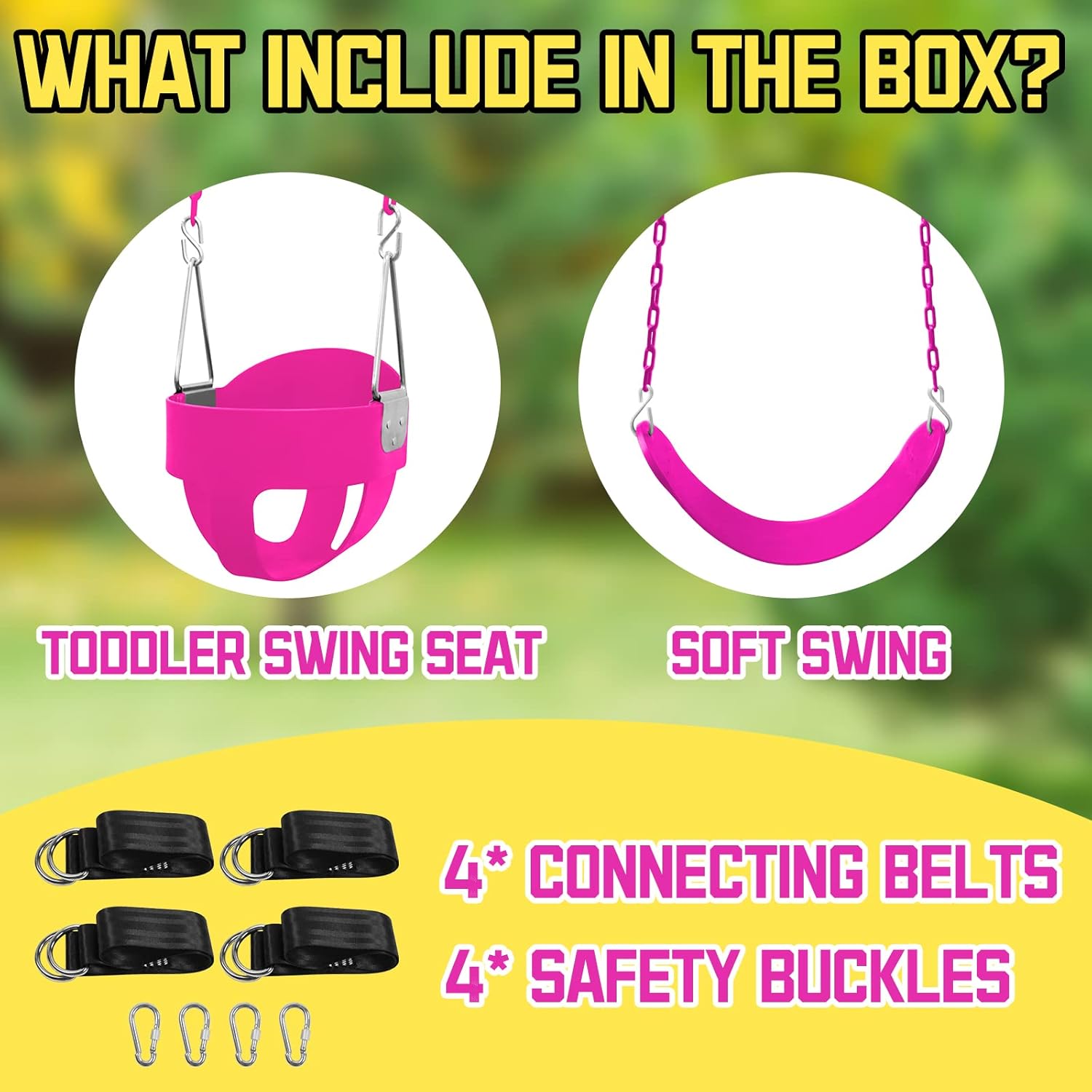
Toddler
$59.99
In stock on Amazon
Check price on AmazonFor buyers sourcing multiple seats for a daycare or preschool, a mid-tier commercial-grade bucket with IPEMA certification documentation is worth the step up:
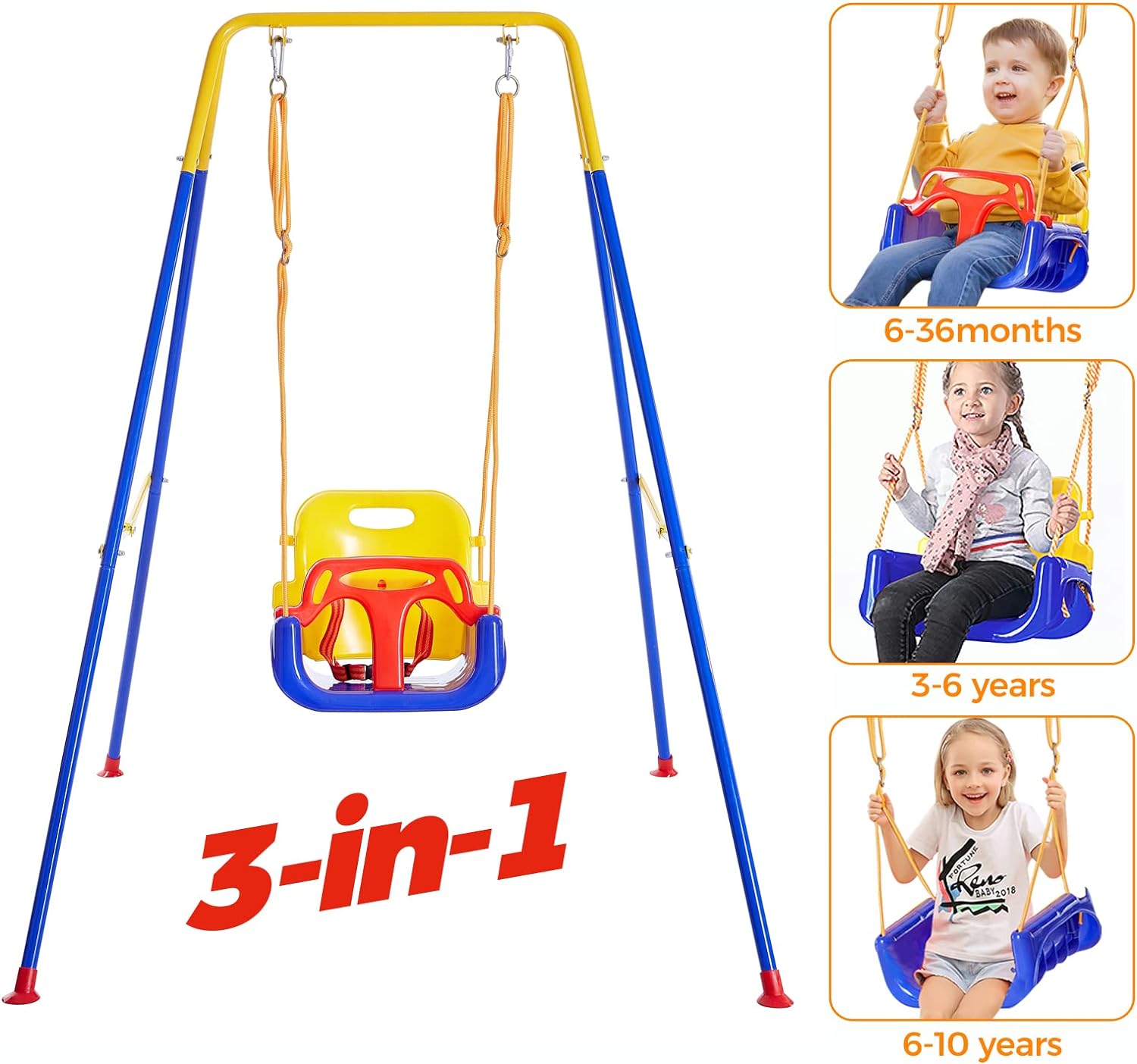
FUNLIO
$84.99
In stock on Amazon
Check price on AmazonThe Growth-Path Problem: Planning for the Child You’ll Have in Two Years
Here’s the honest trade-off most swing set marketing glosses over: a set optimized for an 18-month-old will feel like a poor fit for a four-year-old. The question isn’t whether your child will outgrow the toddler configuration — they will — it’s whether the frame and structure can accommodate the older-child accessories (belt swings, gliders, climbing features) after you swap out the bucket seat.
Three growth-path scenarios:
1. Buy toddler-only, plan to replace. If your child is 2–3 and you’re expecting another baby in the next year or two, a lower-cost toddler-focused set makes financial sense. You’ll get 3–4 years of use, the second child will use it from infancy, and you can buy a larger set around your first child’s fifth birthday. Budget-tier freestanding A-frames with a single bucket seat position can come in under $400.
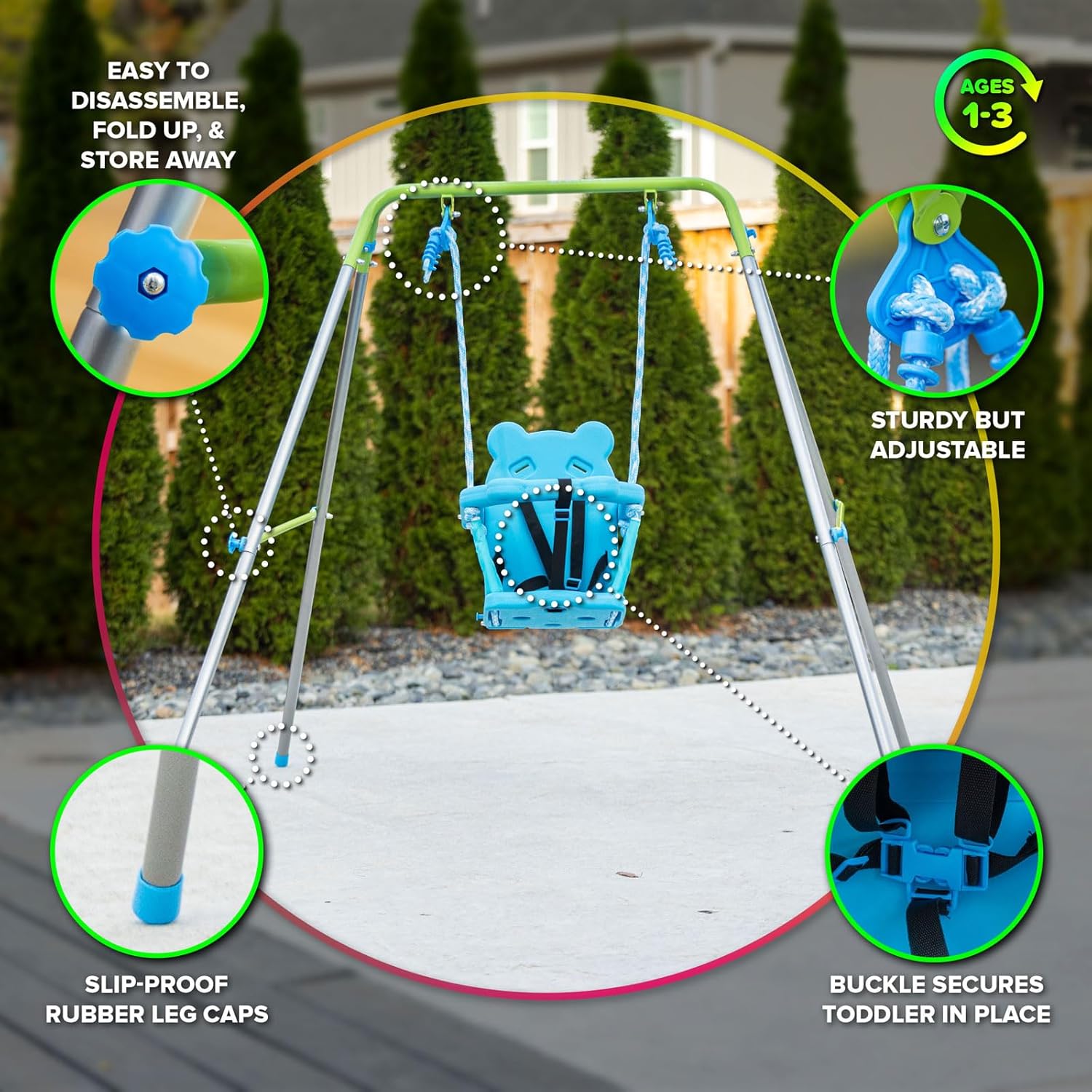
Sportspower
$55.86
In stock on Amazon
Check price on Amazon2. Buy a convertible set now. Many mid-range residential sets ship with a bucket seat but are designed to accept belt swings, trapeze bars, and add-on accessories as the child ages. These sets typically have heavier-gauge steel or cedar lumber rated for users up to 150–175 lbs per swing bay. The upfront cost is higher ($700–$1,500 range as of mid-2026), but the cost-per-year math often favors this path if you have one child and don’t plan to replace the structure.
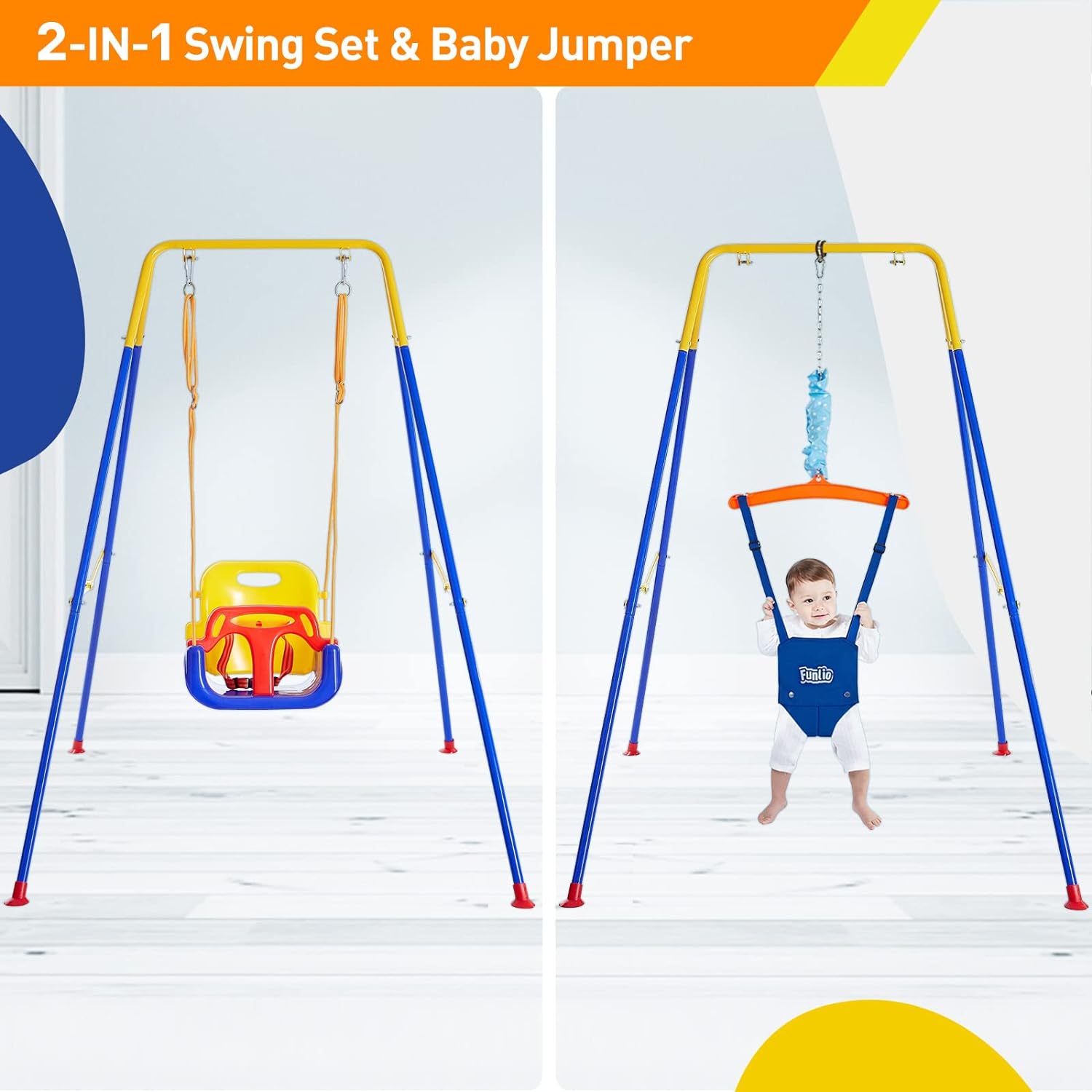
FUNLIO
$119.99
In stock on Amazon
Check price on Amazon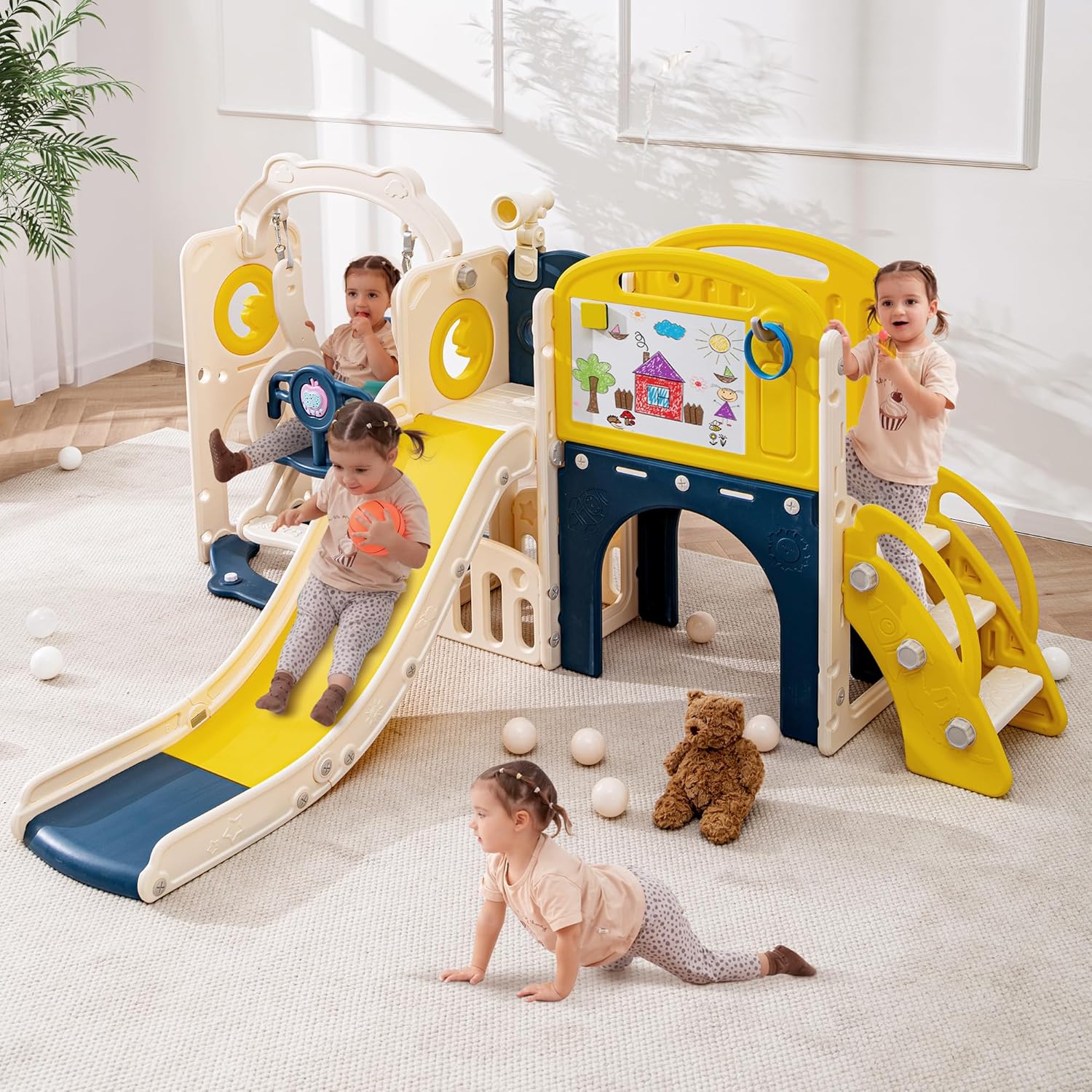
Toddler
$209.99
In stock on Amazon
Check price on Amazon3. Commercial/daycare path. If you’re sourcing for a licensed facility, the growth-path problem inverts: you need a set that serves the widest age band simultaneously, not one child’s trajectory. Here you’re looking at commercial-grade modular frames with multiple swing bays — one or two bucket positions, one or two belt positions — all rated under ASTM F2373 and F1148 simultaneously, with IPEMA certification on file. These systems typically start around $2,000–$4,000 for the base frame and can exceed $10,000 fully specced.
Sportspower
$55.86
In stock on Amazon
Check price on AmazonInstallation, Surfacing, and the True Cost Calculation
The swing set price tag is only part of the story. Here’s where first-time buyers reliably underestimate total spend:
Surfacing: The fall zone beneath a toddler swing needs impact-attenuating surfacing — engineered wood fiber, rubber mulch, poured-in-place rubber, or rubber tiles. The CPSC handbook specifies minimum depth requirements based on fall height. For a 32-inch max toddler platform with a swing bay, 9 inches of engineered wood fiber or 6 inches of rubber mulch is the typical starting spec. Budget $200–$600 for a residential backyard setup; commercial poured-rubber can run $8,000–$15,000 per 1,000 square feet installed.
Installation: Most residential A-frame sets can be assembled by two adults in a half day using manufacturer instructions. Ground anchoring is mandatory — unanchored swing sets tip. For larger structures or commercial applications, professional installation adds $300–$800 for residential and $1,500+ for commercial modular systems.
10-year maintenance: Cedar structures require annual sealing or staining ($50–$100/year in materials). Metal powder-coat frames need occasional touch-up on chips to prevent rust at stress points. HDPE plastic components are essentially maintenance-free but cannot be refinished if faded. Owners of cedar sets in humid climates consistently report that skipping even one year of sealing accelerates visible wear significantly.
For budget-conscious buyers who want quality surfacing without the full rubber-tile investment:
Sportspower
$55.86
In stock on Amazon
Check price on AmazonMaking the Call: If X, Then Y
You’ve done the research. Here’s the decision rule in plain language:
-
If your child is under 24 months and you have one child: Buy a freestanding toddler A-frame with a full-bucket T-bar seat, ASTM F2373 compliance, and closed S-hook hardware. Budget $300–$600 all-in including surfacing. Plan to revisit around age 4.
-
If your child is 2–3 and you want a structure that grows to age 8+: Spend more on the frame now. Look for a convertible mid-range set rated to 150 lbs per swing bay with documented ASTM F1148 compliance and accessory compatibility. Budget $900–$1,600 all-in.
-
If you’re buying for a licensed daycare or preschool: IPEMA certification is non-negotiable — your licensing inspector will ask for it. Budget for commercial-grade frames, professional installation, and poured or tiled surfacing from the start. A $2,500 frame with $4,000 in surfacing and $800 in installation is closer to the real number than any “playground set” sticker price suggests.
-
If the listing says “ASTM compliant” but doesn’t specify F2373: Ask the manufacturer directly before you buy. For toddler ages 1–3, F2373 is the right standard. F1148 alone is not sufficient documentation for this age band.
The CPSC’s published guidance and ASTM’s published standards are free to download directly from cpsc.gov and astm.org respectively — worth ten minutes of reading before any purchase over $500.
FUNLIO
$84.99
In stock on Amazon
Check price on AmazonSportspower
$55.86
In stock on Amazon
Check price on AmazonFUNLIO
$119.99
In stock on Amazon
Check price on Amazon