If you’ve already bought a swing set — or you’re deep enough in the research that you can tell a beam notch from a belt swing — you’ve probably hit the accessories question. Most sets arrive with a basic two-belt-swing-and-a-slide configuration, and the manufacturer’s upsell page lists another dozen add-ons at $30 to $300 each. The pitch is seductive: a rock wall here, a telescope there, a “captain’s wheel” for good measure. The honest truth is that some of those upgrades get used every single day, and some get touched twice before collecting cobwebs. This guide cuts through that noise. Drawing on aggregated long-run owner reports, CPSC and ASTM safety guidance, and design principles from playground industry sources, we ranked the most common swing set accessories by their real-world play value — meaning the ratio of how much kids actually use them versus what they cost. If you’re configuring a new set or retrofitting one you already own, here’s how to spend the next $200 to $1,000 wisely.
The Framework: How We Define “Play Value”
Before getting into rankings, it helps to define the term we’re optimizing for. Play value in this context means the frequency and duration of genuine, child-initiated engagement with an accessory over a 12-to-36-month ownership window — not parental enthusiasm at purchase, not how photogenic it looks, and not how impressive it sounds in a product description.
Owners consistently report a predictable pattern across set types: a small number of elements capture 80 percent of actual play time, and the rest collect seasonal dust. Playground industry research cited on PlaygroundProfessionals.com identifies repetitive, kinetic, and social-play affordances — things kids can do over and over that change slightly each time — as the strongest predictors of sustained engagement. Static props (a steering wheel, a telescope, a mailbox) lose novelty fast. Dynamic elements (swings, slides, climbers, overhead ladders) hold attention across multiple developmental stages.
That framework drives the rankings below.
Tier 1 — High Play Value: Worth Buying First
Belt Swings (Additional Pairs)
If your set shipped with two belt swings and you have more than one child, adding a third or fourth belt swing is arguably the highest-ROI upgrade you can make. Belt swings (the standard, flat rubber-seat swings) are rated for children roughly 5 through 12 under ASTM F1148 guidelines, and they’re the element that owners most consistently report being “in use every time the kids go outside.”
The math is simple: a two-swing set with three kids produces a constant negotiation problem. A third swing eliminates it. Replacement and add-on belt swings are among the most affordable accessories in the category.
 product image](/images/external/4f0b2b5859c6.jpg)
TURFEE
$23.99
In stock on Amazon
Check price on AmazonSafety note: The CPSC’s Handbook for Public Playground Safety (Publication 325) specifies minimum clearance between adjacent swings — typically 24 inches between seats and 30 inches from seat to support structure. Verify your beam has the capacity before adding a third hanger.
Add-On Slide (Especially Spiral or Wave Variants)
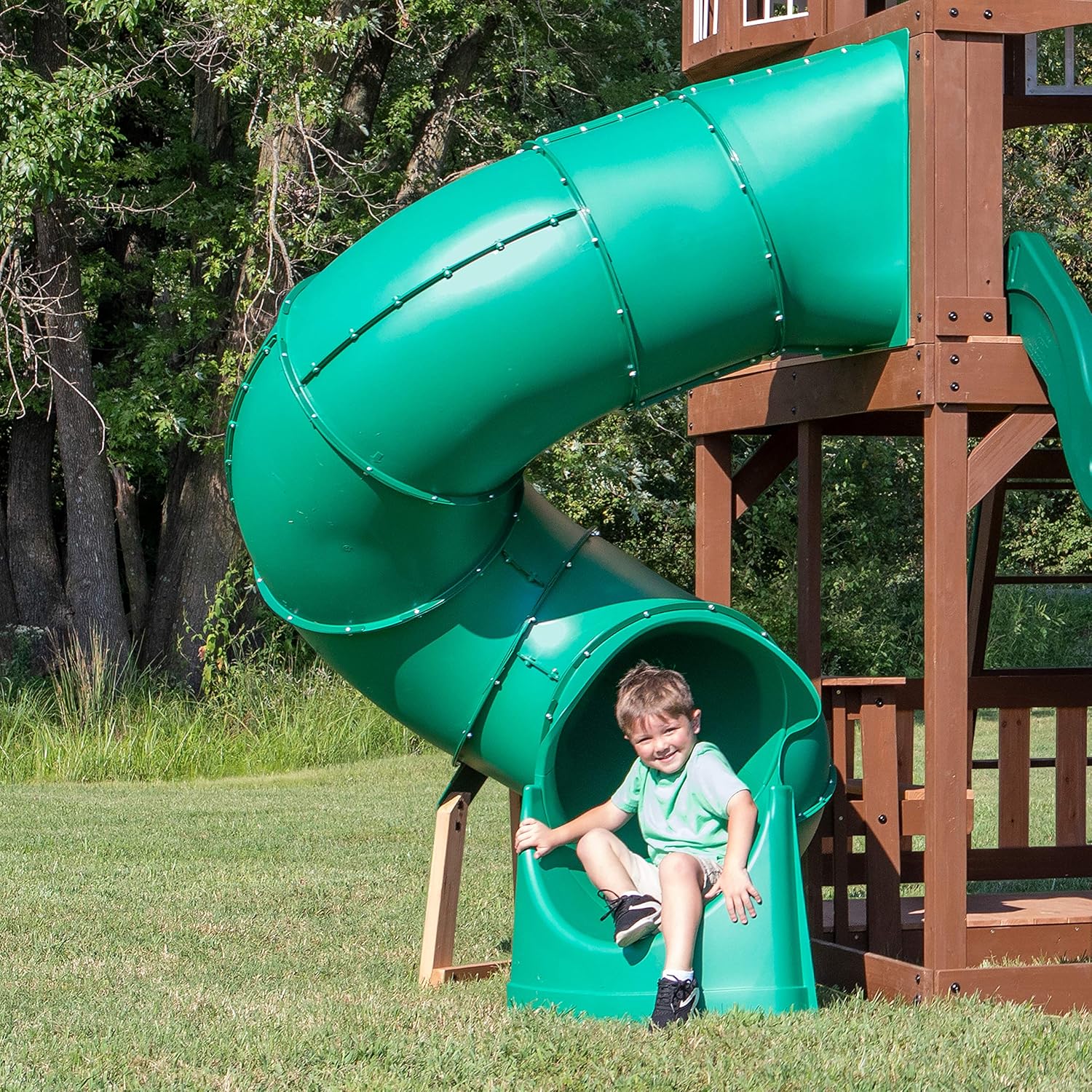
A second slide, particularly one with a spiral or wave profile, consistently outperforms nearly every other add-on in sustained engagement. The reason is replayability: the path down is slightly different each time, and it scales across age groups from toddlers (with supervision) through tweens.
Owners in long-run reviews frequently note that straight slides become “boring” within one season for kids over age 6, while wave and spiral configurations hold interest longer. Wave and spiral slides are also typically rated to higher weight capacities — many are listed at 250 lbs. — making them usable by older kids and the occasional adult helping a toddler.
 product image](/images/external/fcdc8f583eba.jpg)
Gorilla
$72.00
In stock on Amazon
Check price on AmazonClimbing Wall with Attached Rock Holds
A climbing wall — typically a flat or angled wooden panel with molded plastic “rock holds” (the grip footholds bolted through the board) drilled in — is one of the few static structures with genuine high replay value. The reason: kids naturally route new problems. They won’t climb the same path twice. CDC playground safety data notes that upper-body and grip-strength development is a key physical benefit of structured climbing, and the engagement pattern owners report matches that: climbing walls tend to stay relevant from roughly age 4 through 10.
The trade-off to name explicitly: rock holds loosen over time as the wood beneath them swells and contracts seasonally. Published installation guidance from multiple manufacturers recommends re-torquing hardware annually. Budget 20 minutes once a year.
 product image](/images/external/eadd7162b667.jpg)
Swing-N-Slide
$779.00
In stock on Amazon
Check price on AmazonTier 2 — Moderate Play Value: Conditional Buys
Trapeze Bar with Rings
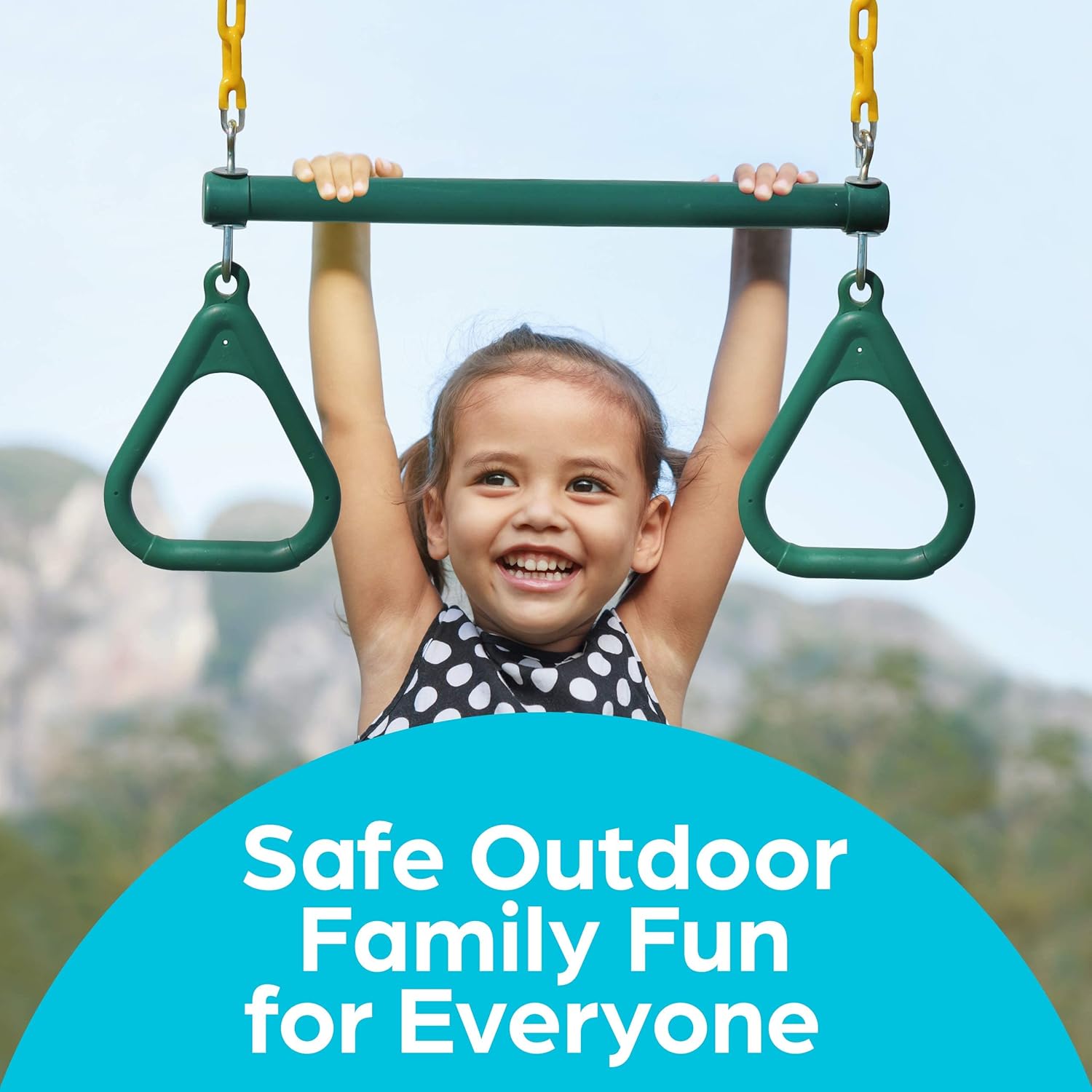
A trapeze bar — a horizontal bar suspended below the main beam with attached gymnastic rings — scores high with specific age groups (roughly 7 to 11) but nearly zero with kids under 5 and declining engagement after about age 12. If your household is currently 6-to-10, it’s a strong buy. If you’re outfitting for a 3-year-old, come back to it in three years.
Owners consistently report that the rings (as opposed to a fixed bar alone) dramatically extend engagement time, because kids invent their own routines. The combined unit is the version worth buying.
TURFEE
$23.99
In stock on Amazon
Check price on AmazonGlider / Buddy Swing
A glider (sometimes called a buddy swing or porch glider) is a facing two-seat swing that moves in a to-and-fro arc when both riders push together. It tests coordination and requires social play by design — which is either its best feature or its limitation, depending on your household.
The honest trade-off: gliders are highly engaging when there are two kids of similar size. With a significant age or size gap, the coordination dynamic breaks down and the element goes unused. Daycare and school installations, where peer groups are age-sorted, get strong use out of gliders. Home installations with one child, or children far apart in age, see lower utilization.
Backyard
$499.00
In stock on Amazon
Check price on AmazonSandbox / Sand Table Add-On
Manufacturers often offer an under-deck sandbox (a bordered sand area that fits beneath the main platform). Owner reports are genuinely mixed. In households with children under age 6, the sandbox frequently ranks among the most-used elements. In households where the youngest is over 7, it typically goes unused within the first season.
The secondary cost issue: play sand requires periodic replacement (contamination from animals, debris, and normal use), and per NRPA park maintenance standards, commercial installations replace sandbox fill on a defined cycle. Residential owners often underestimate this. Budget roughly $40 to $80 per refresh, once to twice annually.
Tier 3 — Low Play Value: Proceed with Skepticism
Steering Wheels, Telescopes, and Panel Props
These are the accessories that photograph beautifully and get used the least. Captain’s wheels, plastic telescopes, and “activity panels” (tic-tac-toe boards, number grids) are static props. They have a novelty arc measured in days, not seasons. PlaygroundProfessionals.com design guidelines consistently place fixed decorative elements at the bottom of sustained-engagement rankings.
The exception: for children with developmental or sensory processing considerations, certain panel activities do maintain longer engagement and may serve a therapeutic play function. For typical developmental ranges, skip them.
Canopy / Sunshade Tents
A deck canopy (typically a fabric shade sail or mini tent that clips to the platform railing) has genuine functional value in hot climates, but owners frequently report that children don’t actually spend more time under the canopy — they simply sweat less when they’re up there. The play value add is minimal; the comfort add is real but limited.
More important: fabric canopies are the highest-maintenance accessory category. Owners report UV degradation, mildew in humid climates, and torn grommets within 2 to 3 seasons. Factor replacement cost into the equation before buying.
Gorilla
$72.00
In stock on Amazon
Check price on AmazonBy the Numbers: Accessory Play-Value Summary
| Accessory | Typical Age Range | Avg. Owner-Reported Longevity | Relative Cost |
|---|---|---|---|
| Additional belt swing | 5–12 | 3–5 seasons | $ |
| Spiral / wave slide | 3–12 | 5+ seasons | $$ |
| Climbing wall w/ holds | 4–10 | 3–4 seasons | $$ |
| Trapeze with rings | 7–11 | 2–3 seasons | $ |
| Glider / buddy swing | 5–10 | 3–4 seasons | $$ |
| Sandbox (under-deck) | 2–6 | Ongoing material cost | $–$$ |
| Steering wheel / props | 3–6 | 1 season | $ |
| Fabric canopy | Any | 1–2 seasons | $ |
Age ranges and longevity estimates aggregated from owner reports across multiple review platforms and installer community discussions. Individual results vary by household composition.
Retrofit vs. Configure-at-Purchase: The Decision That Changes the Math
If you’re still at the configuration stage with a new set, this is the moment to think carefully. Accessories purchased as part of an initial build are almost always cheaper than retrofitting later — not because the component costs less, but because installation labor (if you’re hiring) only gets applied once, and because factory-drilled attachment points are structurally integrated in ways that aftermarket mounting hardware isn’t.
The concrete decision rule:
-
If you’re buying new and have children currently aged 5 to 10, lock in the climbing wall and at least one additional swing at configuration time. These are the two elements with the broadest age overlap and the highest confirmed utilization. Add the trapeze rings only if your kids are already in that 7-plus window.
-
If you’re retrofitting an existing set, prioritize accessories that use the existing beam for attachment (belt swings, trapeze bars, gliders) before anything requiring new structural mounting. New structural hardware on an existing set should be evaluated against the original manufacturer’s load ratings — the CPSC handbook is explicit that residential play equipment load ratings are set per-component and cumulative additions can exceed design limits.
For commercial or institutional buyers (parks-and-rec, school procurement), the NRPA’s maintenance standards and ASTM F1148 compliance documentation should be the governing reference for any add-on evaluation. Aftermarket accessories on ASTM-certified sets should carry their own conformance documentation — don’t assume a third-party add-on inherits the base set’s certification.
Swing-N-Slide
$779.00
In stock on Amazon
Check price on AmazonThe Upgrade Nobody Talks About: Surfacing
This doesn’t make a ranked list because it’s not technically a “swing set accessory,” but no guide to play value is complete without flagging it: the single highest-leverage investment most owners can make after buying a swing set is upgrading the fall-zone surfacing beneath it.
The CPSC Publication 325 lists minimum depths for engineered wood fiber (EWF), rubber mulch, and poured-in-place rubber surfaces at various fall heights. The pattern in owner reports is consistent — cheap sets on bare grass or compacted dirt produce more injuries and more parental anxiety than premium sets on properly installed loose-fill or rubber surfacing.
Swing-N-Slide
$779.00
In stock on Amazon
Check price on AmazonIf your current budget is stretched, defer a decorative accessory and put that $100 to $200 toward a proper surfacing depth under the swing arc. That trade-off improves actual outcomes; the steering wheel does not.
Final Decision Framework
If your children are under 5: prioritize the additional belt swing (add a toddler bucket seat, which has full back and leg support, for children under age 3), a wave slide, and proper surfacing. Skip everything else for now.
If your children are 5 to 10: climbing wall, additional belt swing, and trapeze-with-rings are the core three. A second slide if budget allows. Skip the props.
If you’re buying for a commercial or school setting with mixed ages: modular climbing elements, multiple belt swings, and a glider (for social play development) are the standard high-value configuration per playground design guidelines. Budget for annual hardware inspection and surfacing top-offs — these are operational costs, not optional.
The accessories that get used are the ones that let kids generate novelty themselves. Everything else is furniture.