If you’ve spent any time pricing out a swing set or modular play structure, you’ve probably focused on the frame — the slides, the climbing walls, the baby swings. That’s natural. But what’s under the equipment may be the single most consequential safety decision you make. “Surfacing” is the material layer — wood chips, rubber mulch, poured rubber, sand — that cushions a child if they fall. Falls from playground equipment are the leading cause of playground-related injuries, and the depth and type of that cushion is what determines whether a fall results in a scraped knee or an emergency room visit. The CPSC (U.S. Consumer Product Safety Commission — the federal agency that sets playground safety standards) publishes specific rules for how deep that layer must be and how large the protected “fall zone” (the padded area surrounding the equipment) needs to extend. This guide walks you through those rules in plain numbers, compares the most common surfacing materials across cost and longevity, and ends with a clear decision framework so you know exactly what to buy for your situation.
Why the CPSC Depth Rules Are Non-Negotiable — Even in a Backyard
Here’s the framing most buyers miss: surfacing depth requirements aren’t suggestions. They’re the product of decades of injury data analyzed by the CPSC and codified in its Public Playground Safety Handbook (Publication #325, most recently updated for current standards). The CPSC doesn’t mandate private residential compliance the way it does for public parks, but the underlying physics doesn’t change because your yard is fenced. A 6-year-old falling from a 6-foot platform hits the ground with the same force whether it’s a municipal park or a backyard.
The core CPSC depth rules by equipment height:
| Equipment’s highest accessible point | Minimum loose-fill depth (uncompressed) |
|---|---|
| Up to 5 feet | 6 inches |
| Up to 7 feet | 9 inches |
| Up to 10 feet | 12 inches |
Those numbers are for uncompressed material measured at installation. Loose-fill surfaces like wood chips and rubber mulch compress over time — sometimes dramatically — which is why the CPSC recommends a starting depth roughly 25–30% deeper than the minimum to build in a maintenance buffer. In practice: if your playset’s highest deck is 6 feet, install at least 9–10 inches of rubber mulch, not 6.
The fall zone: The protected surface must extend a minimum of 6 feet in every direction from the equipment’s outer edge. For swings specifically, the CPSC specifies front-and-back coverage equal to twice the height of the swing’s pivot point. So a swing suspended from a 9-foot crossbar needs 18 feet of protected surface in front of and behind the swing’s path. That’s a lot of real estate — and a lot of material — that buyers routinely underestimate when ordering.
ASTM International’s Standard F1292 (Impact Attenuation of Surfacing Materials in the Use Zone of Playground Equipment) provides the technical test behind these numbers: it measures a surface’s “HIC” score (Head Injury Criterion — the calculated severity of impact on a simulated child’s head at a given fall height). A compliant surface must achieve a HIC below 1,000 at the rated fall height. IPEMA (the International Play Equipment Manufacturers Association) runs a third-party certification program that lets manufacturers test and label their surfacing products against F1292 — look for IPEMA certification on any material you’re buying for a public or commercial installation.
Surfacing Materials Head-to-Head: Cost, Durability, and Hidden Trade-offs
You have five realistic options. Here’s where each one wins and where it doesn’t.
1. Engineered Wood Fiber (EWF)
The most widely specified loose-fill for commercial parks. EWF is processed specifically for playgrounds — no splinters, consistent particle size — unlike raw bark mulch, which the CPSC explicitly warns against as a surfacing material (it compacts too fast and can splinter). Owners and park operators consistently report that EWF performs well for 2–4 years before needing meaningful top-off, depending on foot traffic and drainage.
Cost: Roughly $15–$25 per cubic yard (bulk delivery pricing, 2026 Mid-Atlantic/Midwest market average). A standard residential fall zone at 9-inch depth runs 3–5 cubic yards for a single playset.
Trade-off: It migrates. Kids kick it out, rain washes it to the edges, and you need to rake it back toward the equipment monthly. ADA accessibility is marginal — ASTM F1951 (the standard for wheelchair-accessible playground surfaces) rates EWF as conditionally accessible only when properly maintained and installed over a firm sub-base.
2. Rubber Mulch (Shredded Recycled Tire)
The go-to for buyers who want to minimize annual maintenance. Rubber mulch is heavier than EWF, migrates significantly less, and owners report that it holds depth far better over a 3–5 year window. It’s also the most debated material in playground circles, largely because of wire contamination concerns with low-quality product. Buy from a manufacturer with IPEMA certification and crumb rubber that meets the ASTM F1292 standard, and the contamination risk is managed.
Cost: $20–$45 per cubic yard depending on quality and colorant. Budget another 15–20% if you want a non-black color (playground-grade colorants add cost but also mask heat absorption somewhat — rubber mulch in direct sun can get notably hot, a real consideration for toddlers in summer).
Trade-off: Heat retention is the honest downside. Per the CPSC’s Handbook and corroborated by NRPA guidance, rubber mulch surface temperatures in direct sun can exceed safe contact thresholds. Shade structures become a companion purchase in hot climates.
For homeowners who want a set-it-and-forget-it loose fill that won’t need annual top-offs, rubber mulch at the right depth is the practical choice.
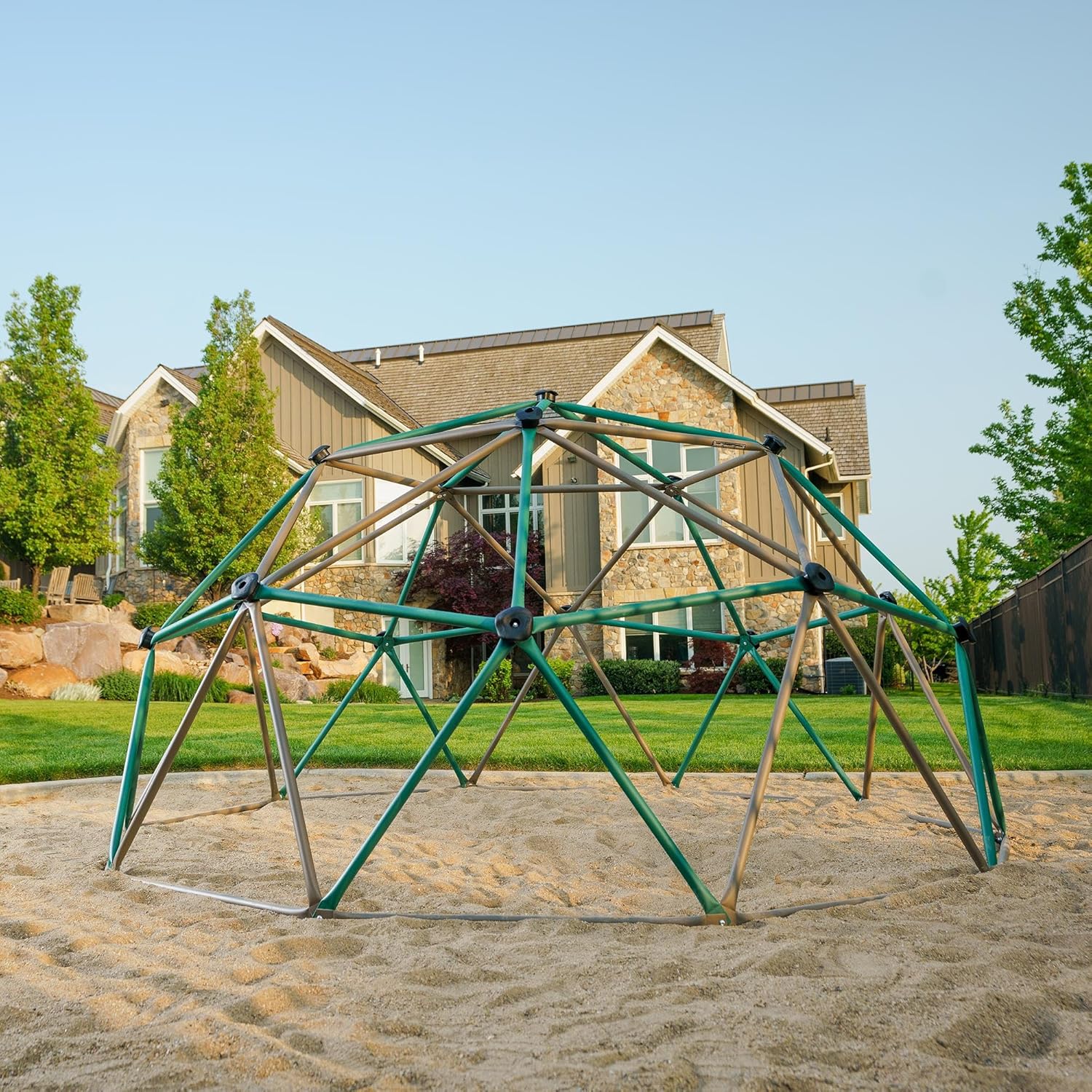
Lifetime
$218.00
In stock on Amazon
Check price on Amazon3. Pea Gravel
Inexpensive and widely available, but the CPSC rates it as a marginal loose-fill surface. It can be displaced to the pavement edge and is a documented ingestion hazard for children under 3. NRPA guidance steers commercial buyers away from it for mixed-age play areas. It remains an option for homeowners with older children (6+) and a very tight surfacing budget.
Cost: $10–$18 per cubic yard — the cheapest loose-fill option.
Trade-off: ADA inaccessible, aspiration risk for toddlers, and it migrates faster than any other option. For most buyers in 2026, this is a false economy.
4. Poured-in-Place (PIP) Rubber
The gold standard for commercial and high-traffic installations. PIP is a two-layer system: a shock-absorbing base layer of crumb rubber topped with a wear layer of EPDM rubber in whatever color and pattern you specify. It’s permanently installed, ADA compliant under ASTM F1951, requires almost no maintenance, and can be designed to drain. The fall-zone area is fixed in place — no migration, no raking.
Cost: $8–$15 per square foot installed, which puts a 30x30-foot fall zone at $7,200–$13,500. That number is why it’s almost exclusively a commercial or premium residential specification.
Trade-off: Upfront cost is 5–8x a loose-fill installation. It also can’t be easily reconfigured if you relocate or expand your equipment.
Lifetime
$218.00
In stock on Amazon
Check price on AmazonFor parks-and-rec or school buyers whose specifications require ADA compliance and minimal maintenance labor, the math on PIP’s 10–15 year lifespan often closes the gap against annual loose-fill replenishment.
Lifetime
$218.00
In stock on Amazon
Check price on Amazon5. Rubber Tiles and Interlocking Mats
A middle path between loose fill and poured rubber. Rubber tiles (typically 2-inch-thick interlocking EPDM or recycled rubber) can be installed without a contractor, meet F1292 at appropriate fall heights, and are genuinely ADA accessible. Owners report they’re practical for smaller residential fall zones where PIP’s cost is prohibitive.
Cost: $3–$8 per square foot for tiles; $5–$12 per square foot for thicker interlocking mat systems designed for higher equipment.
Trade-off: Seams. In high-traffic areas, tiles shift at the edges and seams curl — a tripping hazard that requires periodic re-securing. For a backyard with moderate use, this is manageable. For a public park with 50+ kids per day, you’ll be fighting it constantly.
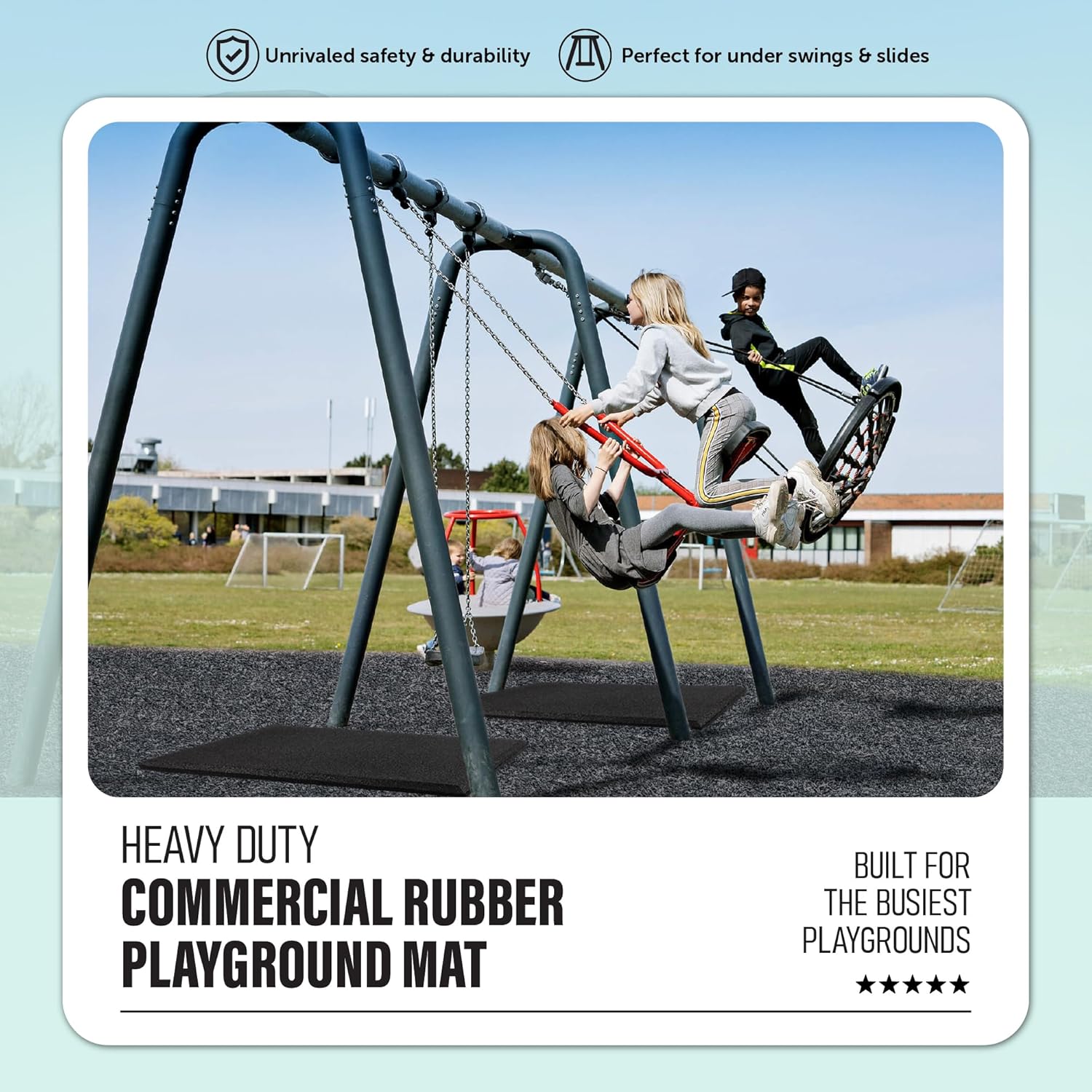
Playsafer
$209.99
In stock on Amazon
Check price on AmazonFor residential buyers who want the simplicity of a hard surface without the PIP budget:
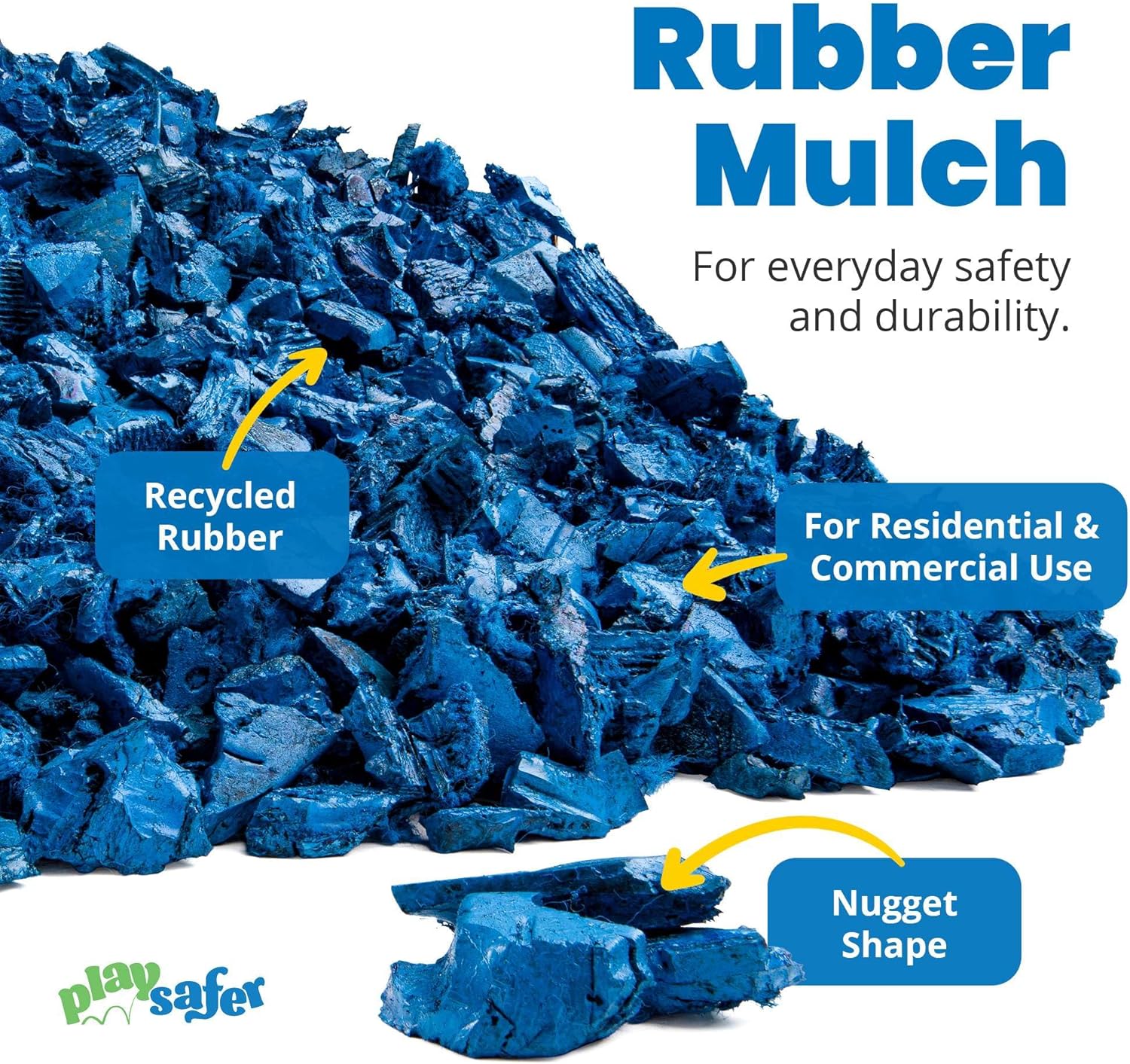
Playsafer
$44.99
In stock on Amazon
Check price on AmazonBy the Numbers: Surface Budget Snapshot (2026 Pricing)
A mid-size residential playset (highest deck: 6 feet, single swing bay) with a compliant fall zone:
- Fall zone area: ~22 × 22 feet = ~484 sq ft
- Rubber mulch at 9 inches: ~13.5 cubic yards → $540–$610 delivered (bulk)
- Rubber tiles at 2.25 inches: ~484 sq ft → $1,450–$3,900 depending on tile spec
- Poured-in-place rubber: ~484 sq ft → $3,870–$7,260 installed
Budget gap between loose fill and PIP: roughly $3,300–$6,700. For a commercial buyer, weigh that against 5 years of annual mulch replenishment ($300–$600/year) and labor.
Decision Framework: If X, Then Y
If you’re buying for a residential backyard, budget under $1,000 for surfacing, and your youngest child is 3+: Install rubber mulch at 9–10 inches depth over a weed-barrier fabric. Plan on raking quarterly and topping off every 2–3 years. Your CPSC compliance gap is a health-and-safety reality even though there’s no inspector coming — invest the depth now.
Playsafer
$44.99
In stock on Amazon
Check price on AmazonIf you’re buying for a residential backyard and want minimal annual upkeep: Budget up to interlocking rubber tiles for the fall zone. The higher upfront cost pays back in zero top-off purchases and the clean look that doesn’t migrate into your lawn.
If you’re a school, daycare, or parks-and-rec buyer with ADA compliance requirements: Spec poured-in-place rubber or rubber tiles with documented IPEMA F1292 and F1951 certification for your target fall height. Loose fill is a liability exposure when accessibility is mandated. The 10-year total cost of ownership on PIP is competitive once you price annual EWF replenishment and labor.
Lifetime
$218.00
In stock on Amazon
Check price on AmazonIf you’re in any installation where children under 3 will play: Remove pea gravel from consideration entirely. The ingestion and aspiration risk documented in CPSC guidance makes it a non-starter for mixed-age environments.
One final rule that costs nothing to follow: measure your fall zone before you order material. Buyers consistently under-order because they measure the equipment footprint, not the CPSC-required 6-foot perimeter — and definitely not the swing overhang. Get the swing math right first, because it usually determines your total material volume more than the main structure does.
Sources referenced in this article: U.S. Consumer Product Safety Commission, “Public Playground Safety Handbook” (Publication #325); ASTM International Standard F1292; ASTM International Standard F1951; National Recreation and Park Association, “Playground Surfacing: The Foundation of a Safe Play Area”; IPEMA Surfacing Certification Program documentation.