If you’ve been looking at those colorful foam block sets that stack, flip, and turn into little climbing structures for your toddler, you’re not imagining things — the category has genuinely exploded in the last few years. These products go by names like “foam climbing blocks,” “soft play sets,” or “sensory gyms,” and the basic idea is simple: modular foam pieces that snap or stack together so kids ages 6 months to around 5 years can climb, slide, tumble, and build at home without a backyard. They’re a real solution to real toddler energy, and for many families — especially those in apartments or cold climates — they’re the closest thing to a playground that fits inside a living room. But here’s where it gets complicated: the safety standards that govern these products are frequently misunderstood, inconsistently applied by manufacturers, and almost never explained clearly on a product listing. This guide is going to fix that. By the end, you’ll know exactly which certifications matter, how to evaluate foam density and cover materials, and how to run a quick entrapment-gap check before anything ships to your door.
| EDITOR'S PICK[BlueWood Pikler Triangle Set wi…](https://www.amazon.com/dp/B0CT5GC65G?tag=greenflower20-20) | Mid-tier[TODIBY 6-Piece Soft PU Leather…](https://www.amazon.com/dp/B0CLY66P3X?tag=greenflower20-20) | Budget pick[Tiny Land Pikler Triangle Set](https://www.amazon.com/dp/B0F3JLBJ8D?tag=greenflower20-20) | |
|---|---|---|---|
| Material | Wood | PU Leather | Wood |
| Foam Type | — | Soft Foam | — |
| Pieces | 7-in-1 | 6-Piece | 7-in-1 |
| Foldable | ✓ | — | ✓ |
| Montessori | ✓ | — | ✓ |
| Price | $139.99 | $89.97 | |
| See on Amazon → | See on Amazon → | See on Amazon → |
What “ASTM Gap Standards” Actually Means for Foam Play Sets
Let’s start with the term buyers see most often and understand least. ASTM International — that’s a global standards organization, not a government agency — publishes voluntary technical standards that manufacturers can choose to follow. The one that applies most directly to foam climbing blocks sold in the U.S. is ASTM F963, formally titled the Standard Consumer Safety Specification for Toy Safety. This document is enormous, but the sections most relevant to climbing blocks are the ones covering entrapment hazards — specifically, gaps and openings that could trap a small child’s head, neck, fingers, or limbs.
The standard identifies two dangerous gap ranges:
- Gaps smaller than 3.5 inches (89 mm) are potentially dangerous because a child’s head can enter but not exit.
- Gaps between 3.5 inches and 9 inches (89–229 mm) are also flagged as entrapment zones — too large to block head entry in some orientations.
A well-designed foam climbing block set should have no structural gaps that fall into either of those ranges when the pieces are assembled as instructed. The problem? Many manufacturers design pieces that are compliant in isolation but create dangerous gaps when stacked in common configurations that toddlers actually use. This is the ASTM gap standard “problem” you’ll hear discussed in procurement circles, and it’s real.
The U.S. Consumer Product Safety Commission — the federal agency with actual recall authority — enforces ASTM F963 as a mandatory standard under the Consumer Product Safety Improvement Act (CPSIA). Per the CPSC’s entrapment hazard guidance, the agency can and does issue recalls for soft foam products that create head-entrapment gaps even if the individual components passed testing. The CPSC’s soft foam product recall database from 2020 through 2025 lists several foam play set recalls specifically citing entrapment hazards in assembled configurations, not individual pieces.
The practical takeaway: Don’t just look for “ASTM F963 compliant” in the listing. Ask whether the product was tested in assembled configurations or only as individual components. Some brands will answer this directly; others won’t, which is itself a signal.
By the Numbers
| Measurement | What it means |
|---|---|
| < 3.5 in (89 mm) | Head-entrapment risk (too small to pass, too large to miss) |
| 3.5–9 in (89–229 mm) | Entrapment zone — gaps in this range should not exist in assembled play structures |
| ≥ 1.6 lb/ft³ foam density | Minimum acceptable density for load-bearing climbing use (most quality sets are 1.8–2.2 lb/ft³) |
| IPEMA certification | Third-party-verified compliance, not self-reported — the gold standard for indoor soft play |
Foam Density and Cover Material: The Two Variables That Predict Longevity
Gap compliance is the floor. Durability is what separates a set that survives 18 months of real toddler use from one that compresses into uselessness within six weeks.
Foam density is measured in pounds per cubic foot (lb/ft³). This isn’t a number most product listings advertise prominently, but it’s worth hunting for. The American Academy of Pediatrics’ guidance on safe toy selection for young children consistently emphasizes that materials used in climbing and active-play products should be firm enough to prevent collapse under body weight — a compressed foam piece can itself become a suffocation hazard. In practice:
- Below 1.6 lb/ft³ — Often found in budget sets. Compresses significantly under the weight of an average 2-year-old (roughly 27–30 lbs) within weeks of regular use. Not recommended for climbing configurations.
- 1.8–2.0 lb/ft³ — The sweet spot for residential use. Firm enough to hold shape across a reasonable lifespan, soft enough to absorb impact from falls.
- 2.0 lb/ft³ and above — Premium territory, often found in commercial soft play sets designed for daycares or playrooms with multiple children.
Cover material matters almost as much as foam density, because the cover is what takes direct abrasion, drool, spills, and the occasional toddler bite. The two dominant materials are:
- PU leather (polyurethane-coated fabric): Wipe-clean, relatively puncture-resistant, and the standard choice for mid-tier and premium sets. Look for a denier rating above 600D if the listing includes it — higher denier = thicker, more tear-resistant fabric.
- Fabric/canvas covers: Softer to the touch, often machine-washable (a genuine selling point for parents of toddlers), but more susceptible to tearing along seams and zipper failure. Zipper quality is the weak link — exposed metal zippers present both a choking hazard and a sharp-edge risk. CPSC guidance specifies that zipper pulls on children’s products should be recessed or covered.
If X, then Y: If your household has more than one child using the set simultaneously, or if you’re buying for a daycare, the cover material calculus flips decisively toward PU leather at 600D+. The machine-washability of fabric covers is appealing, but it doesn’t survive the wear rate of commercial use.
IPEMA Certification: The One Mark That Does the Heavy Lifting
You’ll see a lot of certification claims on foam climbing block listings — “CE marked,” “CPC certified,” “ASTM compliant.” Here’s how to rank them for indoor soft play:
IPEMA (International Play Equipment Manufacturers Association) runs a third-party certification program specifically for play equipment, including indoor soft play products. Unlike self-reported ASTM compliance, IPEMA certification requires an independent lab to verify that a product meets the standard — and that testing covers assembled configurations. Per IPEMA’s Indoor Play Product Certification Program documentation, certified products are re-tested when the manufacturer makes design changes.
CPC (Children’s Product Certificate) is a federal requirement under CPSIA — every manufacturer selling children’s products in the U.S. must have one. But the CPC is a document, not a certification mark. It means the manufacturer claims compliance; it doesn’t mean a third party verified it. Don’t count a CPC as equivalent to IPEMA certification.
CE marking is a European conformity mark. It indicates the product meets EU toy safety standards (EN 71), which have their own gap and entrapment requirements. CE compliance is meaningful but doesn’t map perfectly to U.S. CPSC requirements — it’s a decent secondary signal, not a replacement for U.S.-specific certification.
The practitioner’s decision rule: For home use with one or two children, a well-documented CPC plus a manufacturer that will answer specific questions about assembled-configuration testing is acceptable. For any commercial or semi-commercial application — daycare, school, family daycare home — IPEMA certification should be a hard requirement in your procurement specs. Don’t accept self-reported compliance for a setting where children other than your own are in your care.
How to Shop by Age Range and Configuration
Foam climbing block sets are marketed broadly as “toddler toys,” but the honest developmental window is narrower than the listings suggest.
- 6–18 months: Look for flat mat configurations only — no stacking above 8 inches. The climbing and incline features are developmentally premature and create fall-from-height risks that exceed what the foam can safely absorb.
- 18 months–3 years: This is the core use window. A standard 5–6 piece set with a triangle climber, arch, and flat mat section is well-matched to this stage. Maximum assembled height of 18–24 inches is appropriate.
- 3–5 years: Kids at this age will push the limits of any soft play set. This is where foam density matters most — a 40-lb four-year-old exerts meaningfully more compression force than a 25-lb two-year-old. Sets with 2.0+ lb/ft³ foam and reinforced seams will hold up; budget sets often don’t.
For families at the 18-month–3-year stage looking to start with a solid entry-level set without overcapitalizing:
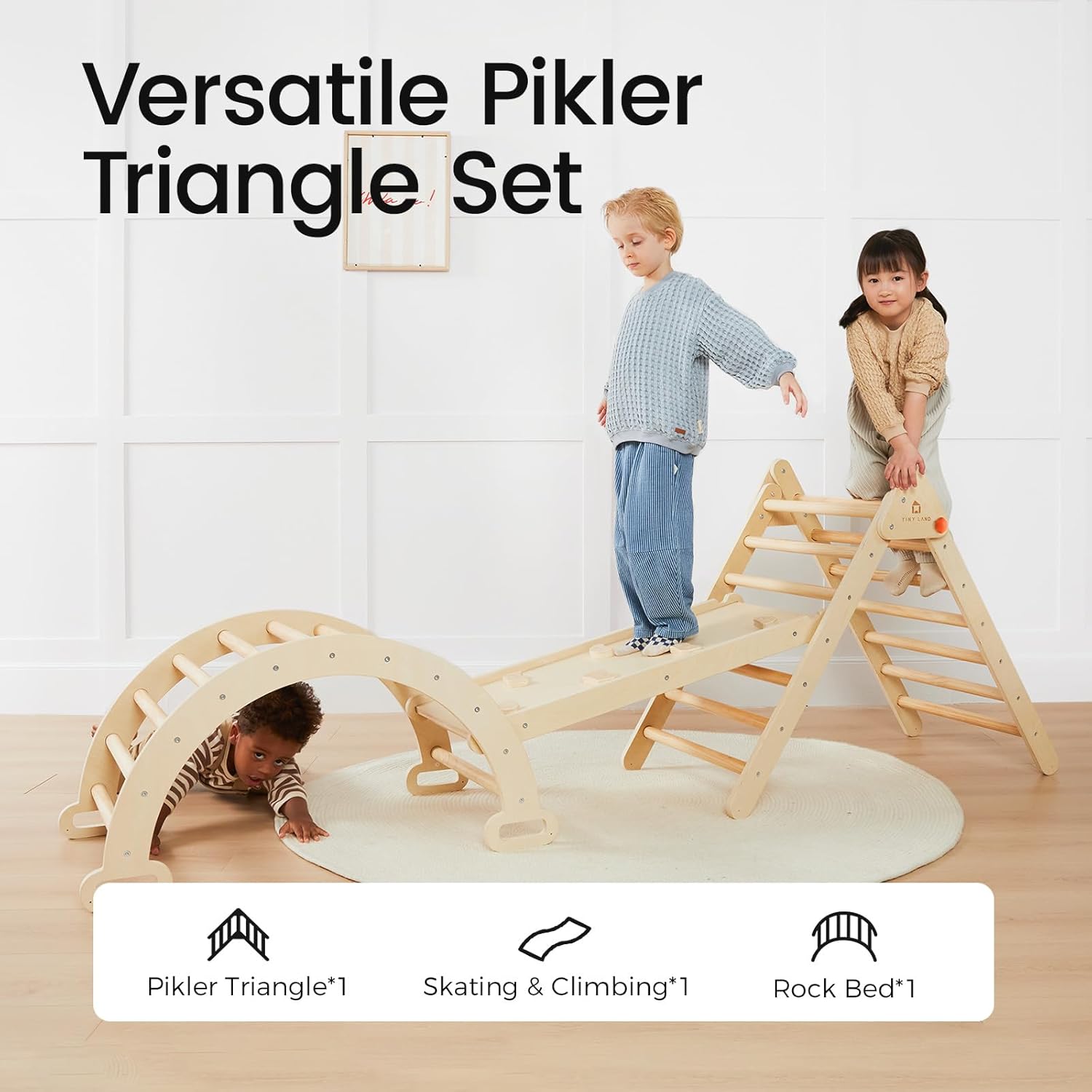
Tiny
In stock on Amazon
Check price on AmazonFor the 2–4-year range where a child is ready to use inclines, arches, and more varied configurations — and where you want cover durability that keeps up with genuine daily use:
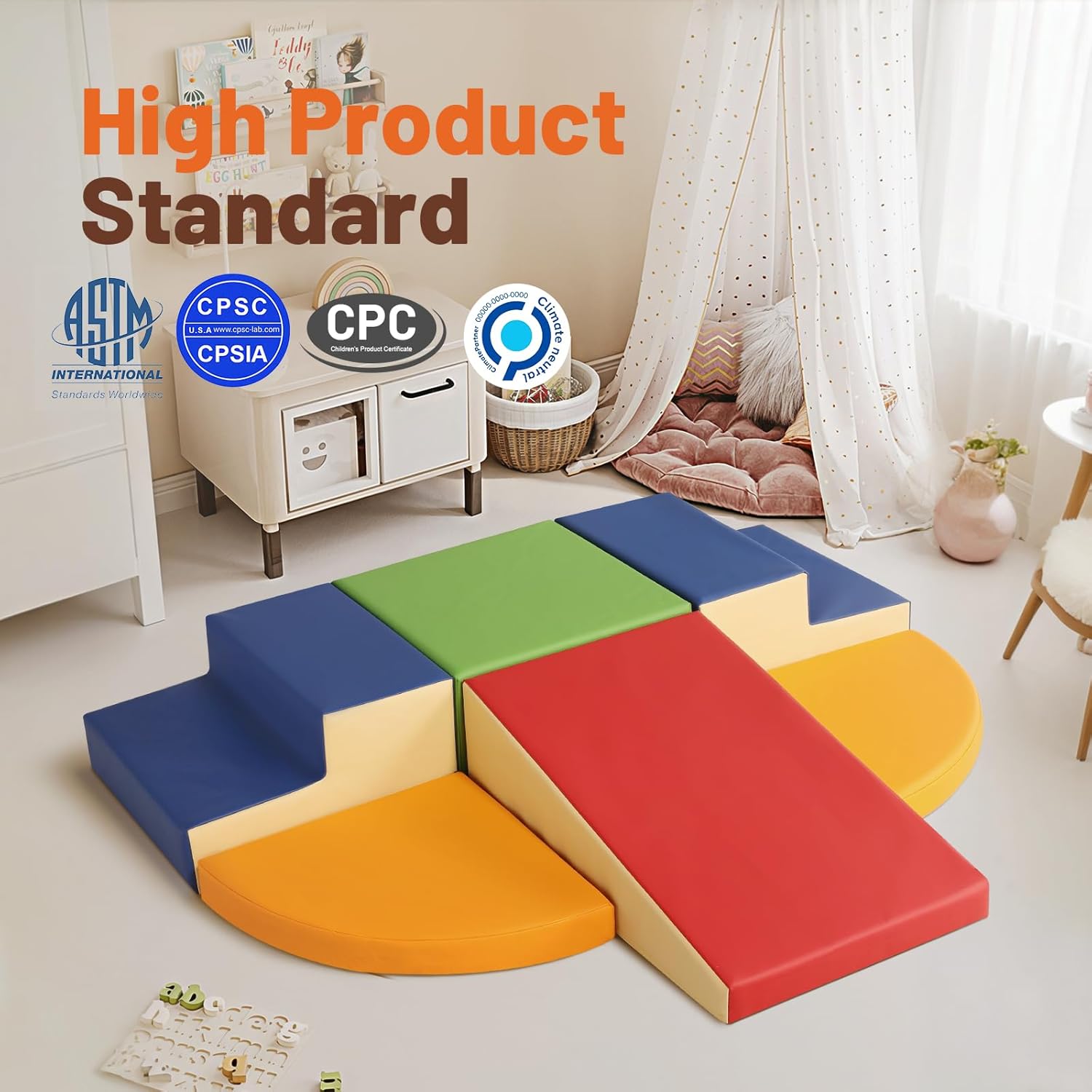
TODIBY
$89.97
In stock on Amazon
Check price on AmazonIf you’re outfitting a home daycare or a residential playroom that sees consistent use by multiple children, or if you simply want a set that grows with your child from 18 months to age 5 without replacement:
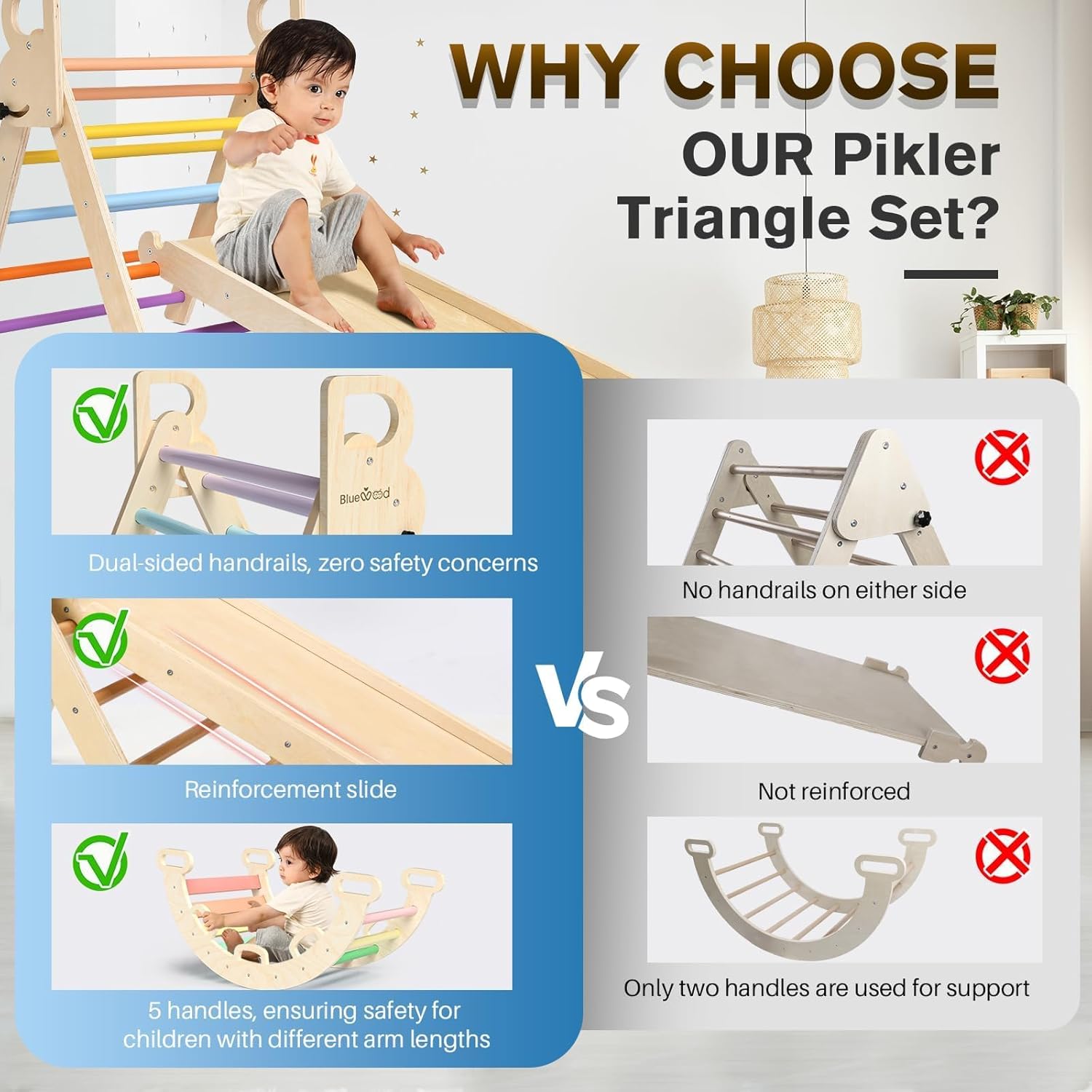
BlueWood
$139.99
In stock on Amazon
Check price on AmazonThe Total Cost Frame: Don’t Price the Set in Isolation
Foam climbing block sets run from roughly $80 on the low end to $400+ for premium multi-piece configurations as of mid-2026. That sticker spread seems manageable — but the real cost question is durability-adjusted price per month of useful life.
Owners of budget-tier sets (sub-$120) consistently report in aggregated reviews that foam compression becomes noticeable within 3–6 months of daily use, and cover seam failures show up at 6–12 months. A $90 set replaced once a year costs $90/year. A $200 mid-tier set that owners report lasting 2–3 years with daily toddler use costs $67–$100/year — and doesn’t involve the disruption and waste of sourcing a replacement.
The math is even clearer for commercial buyers: a $350 IPEMA-certified premium set that holds up to multi-child daily use for 3+ years is categorically cheaper over a procurement cycle than two rounds of sub-$150 replacements that each require disposal logistics and gap-recertification review.
BlueWood
$139.99
In stock on Amazon
Check price on AmazonBlueWood
$139.99
In stock on Amazon
Check price on AmazonThe “If X, Then Y” Decision Summary
Here’s the shortcut for wherever you are in your decision process:
- If you’re buying for a child under 18 months, then skip climbing configurations entirely — flat foam mats with ASTM F963 compliance are the right product category.
- If you’re buying for a home with one child aged 18 months–3 years and a moderate budget, then a mid-tier set with documented CPC and PU leather covering at 1.8 lb/ft³+ is your target. Ask the retailer or manufacturer whether assembled-configuration testing was performed.
- If you’re buying for a daycare, family childcare home, or any setting where you are legally responsible for other people’s children, then IPEMA certification is non-negotiable. Build it into your procurement spec language the same way you’d specify ASTM certification for outdoor equipment.
- If longevity and foam integrity over 3+ years is your priority, then prioritize foam density (2.0 lb/ft³+) and PU leather at 600D+ over any feature set — configuration variety matters less than structural durability.
- If a listing can’t tell you the foam density or whether assembled-configuration gap testing was performed, then treat that as a yellow flag and contact the manufacturer directly before purchasing. Reputable brands in this category will answer those questions readily.
The foam climbing block market is maturing fast, and more manufacturers are coming to market with legitimate third-party certifications. That’s good news for buyers — it means the baseline is rising. But it also means the gap between certified and self-reported products is increasingly meaningful, because the certified tier is now attainable at reasonable price points. Do the certification homework once, get it right, and you’ll have a play set that earns its place in your living room for years.