If your kids have ever made a beeline for the big geodesic dome at a park — that half-sphere made of steel bars that kids scramble all over like ants on a hill — you already know the appeal. Dome climbers and monkey bar structures (horizontal ladders kids hang from and travel across, hand-over-hand) are two of the most popular freestanding play pieces on the market, and they show up in backyards, school yards, and commercial parks alike. What most buyers don’t realize until they’re deep in the research is that these two structure types have specific safety rules around rung spacing, fall height, and age range that are baked into U.S. safety standards — and ignoring those specs is how a $400 purchase becomes a liability. This guide breaks down those rules in plain language, maps them to real buying decisions, and gives you the decision framework to choose the right structure for the right age.
What the ASTM Standards Actually Say About Rung Spacing
ASTM International (a nonprofit standards organization; their documents set the technical floor for most playground equipment sold in the U.S.) publishes two main documents relevant here:
- ASTM F1148 governs residential (home/backyard) playground equipment.
- ASTM F1487 governs public-use (school, park, daycare) play equipment.
Both documents address what engineers call entrapment hazards — gaps that could trap a child’s head, neck, or torso. For climbing structures specifically, the standards define two critical measurements:
Rung spacing (the gap between individual bars or rungs): Per ASTM F1148 and ASTM F1487, openings between 3.5 inches and 9 inches are the danger zone for head entrapment. A compliant structure must have openings that are either less than 3.5 inches (too small for a head to enter) or greater than 9 inches (large enough that a head can exit freely). Anything in between is a fail.
For monkey bars specifically, rung-to-rung spacing along the travel direction must also account for a child’s reach arc. Most manufacturers targeting ages 5–12 use spacing between 9 and 15 inches horizontally to match average arm extension at those ages. A child who can’t bridge the gap between rungs will drop; space them too close and you’ve turned a strength challenge into a stepping stool that defeats the purpose.
By the numbers:
| Measurement | Danger Zone (non-compliant) | Compliant Range |
|---|---|---|
| Head-entrapment opening | 3.5 in – 9 in | < 3.5 in or > 9 in |
| Monkey bar rung pitch (ages 5–12) | < 9 in (too easy to skip; entrapment risk) | 9–15 in typical |
| Dome climber bar diameter | < 0.95 in (hand-grip fail) | 0.95–1.55 in per ASTM F1487 |
Sources: ASTM F1148, ASTM F1487, CPSC Handbook for Public Playground Safety Publication No. 325.
Age-Appropriate Fit: The Decision You Have to Make Before You Buy
Here’s where a lot of buyers go wrong: they buy by price tier when they should be buying by developmental stage. The CPSC (U.S. Consumer Product Safety Commission) Handbook No. 325 segments playground equipment into two age bands: 2–5 years and 5–12 years. Dome climbers and monkey bars straddle that divide in different ways, and the mismatch has consequences.
Dome Climbers
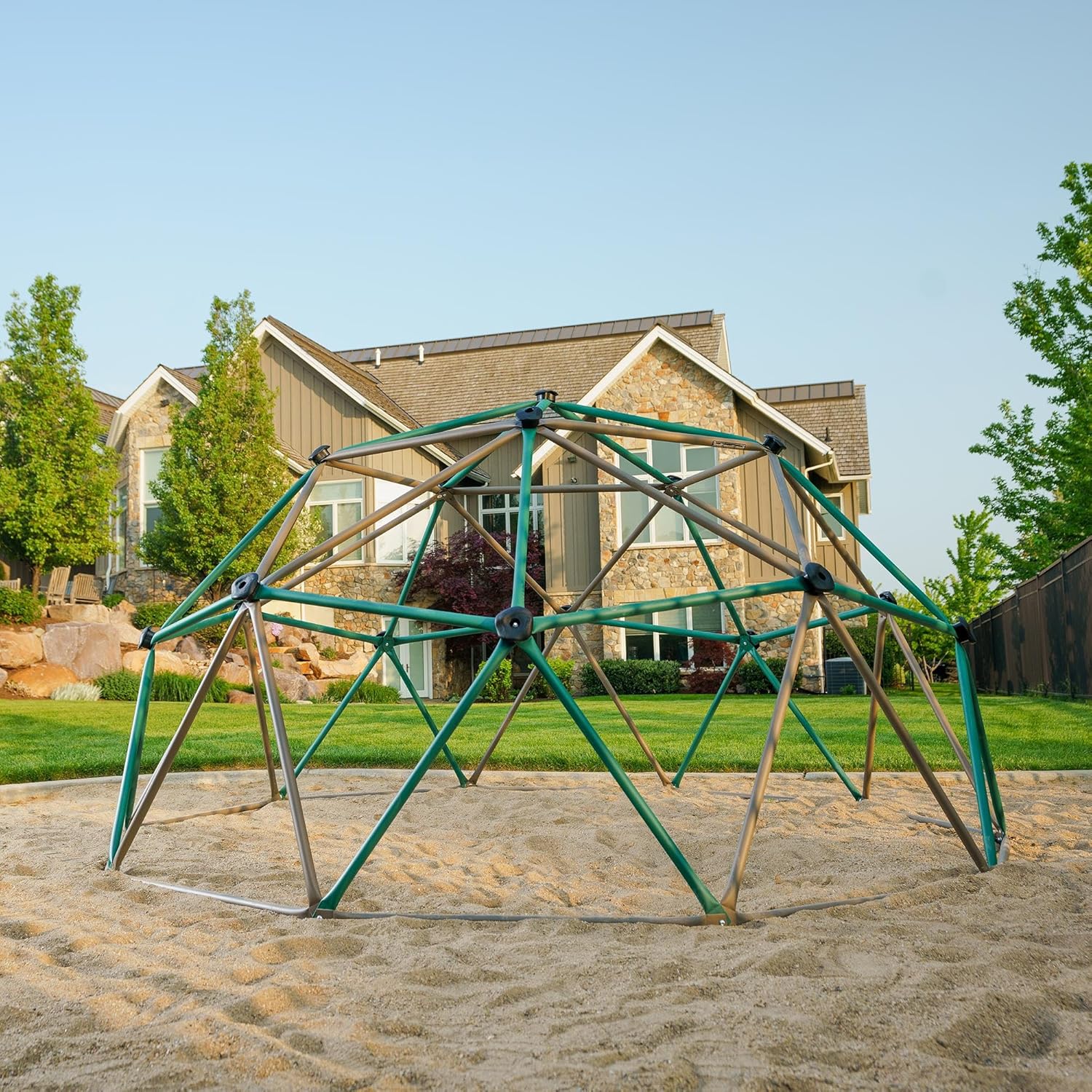
A dome climber — the geodesic half-sphere — works for a wider age spread than monkey bars because the climbing motion is multi-directional and lower to the ground. A 3-year-old can grip adjacent bars and move laterally at the base; a 10-year-old is cranking over the top. The variable that shifts with age is maximum height of the climbing surface:
- Residential domes rated for ages 3–10 typically max out at 4–5 feet to the apex, with fall zones requiring 6 feet of appropriate surfacing (engineered wood fiber, rubber mulch, or poured-in-place rubber) on all sides. Per ASTM F1148, any residential structure with a designated play surface above 30 inches requires compliant impact-attenuating surfacing underneath.
- Commercial domes rated for ages 5–12 may reach 6–8 feet to the apex and require a minimum 6-foot use zone measured from the outermost bar — not from the anchor point. The NRPA (National Recreation and Park Association) notes in their playground safety overview that commercial installations frequently fail this use-zone calculation because installers measure from the post, not the bar perimeter.
What this means for your purchase: If you’re buying for a mixed-age group — say, a daycare serving ages 2 through 10 — a mid-height dome (4.5–5 ft apex) with bars spaced under 3.5 inches throughout is almost always the safer, more versatile choice than a taller model with wider bar gaps marketed to older kids.
For residential buyers with children ages 3–7, a smaller dome in the $150–$300 range covers the peak use window.
 product image](/images/external/0b8475139a2e.jpg)
Backyard
$798.00
In stock on Amazon
Check price on AmazonFor families with kids already in the 5–10 range who want a structure that will last another five years without feeling babyish, a mid-size dome with a higher apex is the call.
 product image](/images/external/523a597243ae.jpg)
Hapfan
$332.49
In stock on Amazon
Check price on AmazonMonkey Bars
Monkey bars require a minimum level of upper-body strength and grip endurance that most children don’t develop reliably until age 5–6, which is why ASTM F1148 explicitly tags overhead ladder/monkey bar structures as appropriate for the 5–12 age group, not the 2–5 group. The CPSC Handbook reinforces this: it lists overhead rings, parallel bars, and horizontal ladders under equipment appropriate only for children 5 and older.
The practical implication: if you’re procuring for a setting that serves children under 5, a standalone monkey bar structure either needs to be out of the 2–5 zone, fenced off, or absent entirely. “Multi-age” marketing on a product listing does not override these standards.
For school or daycare procurement buyers: IPEMA (International Play Equipment Manufacturers Association) certification is your shortcut. IPEMA certifies products against ASTM F1487 through third-party testing; an IPEMA mark on a commercial monkey bar structure means the rung spacing, bar diameter, and structural load ratings have been independently verified — not just claimed in a spec sheet. Per the IPEMA Certification Program Overview, products are re-evaluated on a rolling basis, so check that the certification is current, not pulled from a three-year-old product page.
For commercial buyers writing a spec or going out to bid, monkey bar structures in the $500–$1,200 range cover most school-yard and daycare applications with ASTM F1487 compliance.
Lifetime
$218.00
In stock on Amazon
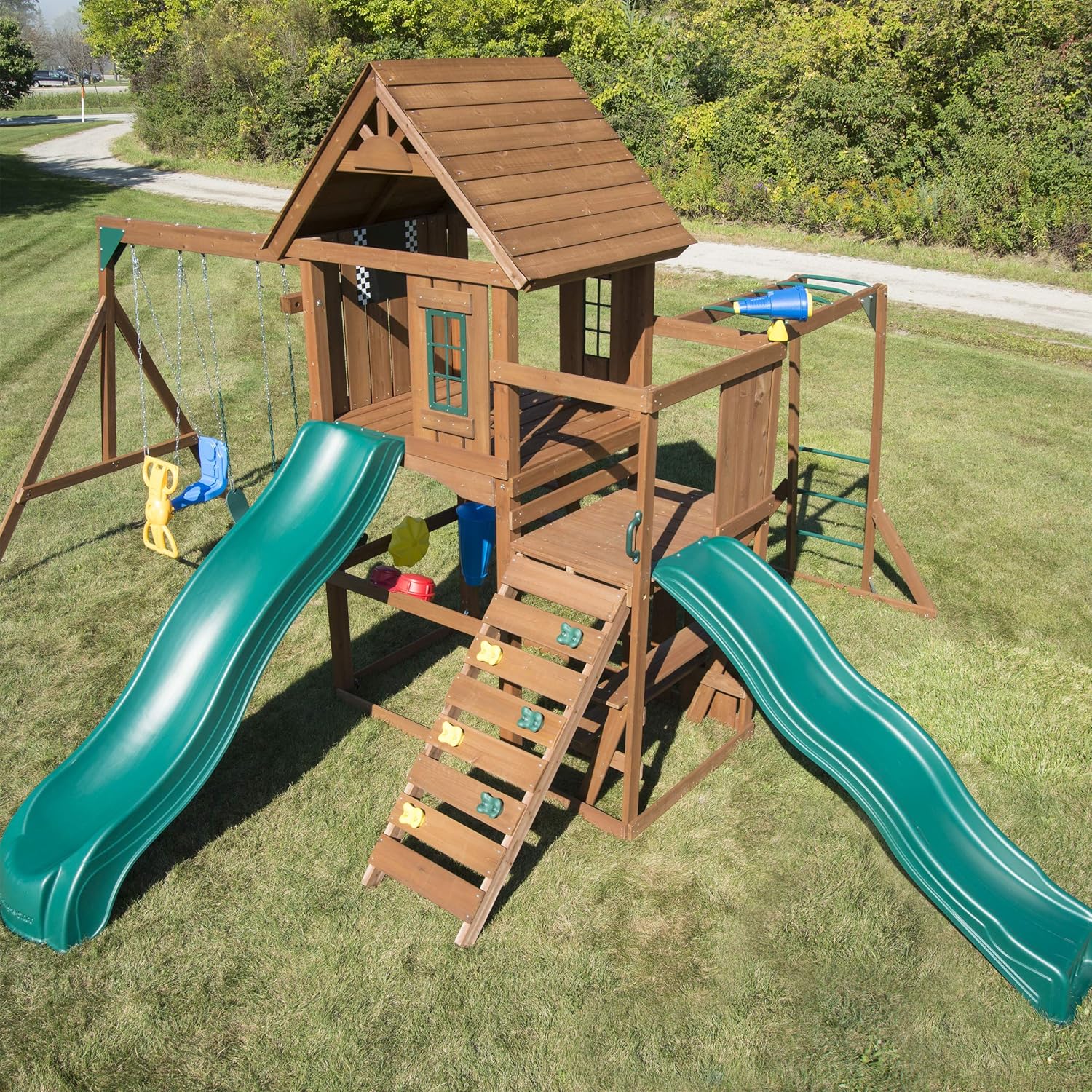
Check price on AmazonFor parks-and-rec buyers with larger budgets building out a full fitness trail or adventure zone, premium freestanding bar structures with modular add-ons are worth the step up.
Swing-N-Slide
$1,688.93
In stock on Amazon
Check price on AmazonMaterial and Durability: What Holds Up Under Real Use
Dome climbers and monkey bars take more sustained stress than most other play equipment — kids hang from them, swing laterally, and pile on in groups. Material choice is where total cost of ownership diverges fast.
Galvanized steel: The commercial standard. Powder-coated galvanized steel is the dominant material in ASTM F1487-compliant commercial structures. Owners of commercial steel domes consistently report 10–15 year lifespans with routine inspection and bolt re-torquing; the failure point is almost always anchor hardware at ground level, not the climbing bars. Rust at weld points is the early-warning sign; inspect annually.
Powder-coated carbon steel (residential): The mid-tier residential norm. Budget residential domes in the $150–$350 range are typically carbon steel with a powder-coat finish. Long-run owner reports note that finish degradation starts around year 3–5 in high-UV / high-humidity climates. Touch-up paint extends lifespan; neglect accelerates rusting at bolt holes.
HDPE (high-density polyethylene) paneling with steel frame: Some newer residential domes use HDPE panels over a steel armature to eliminate sharp bar protrusions. Per published specs, HDPE resists UV degradation better than powder-coat finishes on thinner steel. Owners note the trade-off is rigidity — HDPE-panel domes feel less “industrial” and have lower published weight ratings than all-steel models.
What to ask before you buy:
- What is the published maximum weight capacity — and is it total (all users simultaneously) or per-node?
- Are the anchor hardware and connection hardware stainless steel or zinc-plated? (Zinc-plated corrodes faster in ground contact.)
- Is the structure IPEMA-certified or only ASTM-compliant per manufacturer self-attestation? For commercial purchases, that distinction matters at inspection time.
For residential buyers who want something in the $400–$800 range with solid steel construction and a clear age range:
Hapfan
$332.49
In stock on Amazon
Check price on AmazonLifetime
$218.00
In stock on Amazon
Check price on AmazonSurfacing: The Cost Line Everyone Underestimates
Neither a dome climber nor a monkey bar structure is safe without proper impact-attenuating surfacing underneath and in the fall zone. This is not optional; it is a standards requirement and, in commercial settings, a liability exposure.
The CPSC Handbook No. 325 provides fall-height-to-depth tables for the most common loose-fill and unitary surfacing materials. Quick decision rules for 2026 material costs:
- Engineered wood fiber (EWF): $8–$14/cubic foot installed. Best residential-to-light-commercial value. Requires periodic raking and replenishment (roughly annually).
- Rubber mulch: $12–$18/cubic foot installed. Lower maintenance than EWF; owner reports cite better longevity in wet climates.
- Poured-in-place (PIP) rubber: $10–$20/sq ft installed. Only option that is ADA-compliant for wheelchair access routes; required for commercial installs serving users with mobility limitations. High upfront cost, low 10-year maintenance.
Budget this before you commit to the structure price. A $400 dome climber requiring a 12-foot-diameter fall zone with 9 inches of EWF can add $300–$600 in surfacing costs before you’ve driven a single anchor.
The Decision Frame: If X, Then Y
Here’s the clean decision matrix based on everything above:
If you’re buying for ages 3–5 only (home or small daycare): Choose a dome climber with an apex under 5 feet, all openings under 3.5 inches, and ASTM F1148 compliance. Skip the monkey bars — they’re developmentally premature and a supervision burden.
If you’re buying for ages 5–10 (home or small school): A mid-height dome or a short monkey bar set (under 7 feet high, 9–12 inch rung pitch, ASTM F1148 compliant) works. If budget allows only one, owners consistently report domes get more sustained use across that age range.
If you’re procuring for a commercial setting (school, park, daycare, age 5–12): ASTM F1487 + IPEMA certification is non-negotiable. Steel construction, galvanized hardware, and a documented fall-zone layout are what you bring to a site plan review. Budget $800–$2,000 for the structure and match it to a surfacing budget of equal or greater size.
Lifetime
$218.00
In stock on Amazon
Check price on AmazonIf you’re buying for a multi-age household (ages 3–12) and want one structure that grows: A mid-size dome with a 5-foot apex, all-steel construction, and ASTM F1148 compliance is the most defensible single purchase. It won’t challenge your 10-year-old as much as a full monkey bar run, but it will be safe for your 3-year-old today and still get use at 8.
Swing-N-Slide
$1,688.93
In stock on Amazon
Check price on AmazonThe rung-spacing rules aren’t bureaucratic fine print — they’re the engineering distillation of decades of injury data. A structure that carries an ASTM mark has cleared that bar. One that only claims compliance without third-party certification hasn’t. For a purchase you’ll make once and live with for a decade, that distinction is worth the fifteen minutes it takes to verify.