A backyard swing set sounds simple until you start shopping and realize the price tags range from $150 to $15,000 — and nobody is explaining why. If you’re somewhere in the $200–$500 range (let’s call that the “entry tier” — sets priced low enough to hit impulse-buy territory but still marketed as durable, real-use equipment), you’re asking a very practical question: is this actually enough, or am I just buying something that falls apart in two summers? This guide answers that directly. We’ll walk through what you genuinely get at this price point, what gets quietly left out, and how to tell whether the entry tier fits your situation or whether stretching your budget is the smarter play. No filler. Just the honest trade-off map.
| EDITOR'S PICK[Backyard Discovery Buckley Hill…](https://www.amazon.com/dp/B07ZZKCV56?tag=greenflower20-20) | Mid-tier[KidKraft Appleton Wooden Swing…](https://www.amazon.com/dp/B075MMXC89?tag=greenflower20-20) | Budget pick[Trekassy 440lbs Capacity Swing…](https://www.amazon.com/dp/B0FCS7J6C7?tag=greenflower20-20) | |
|---|---|---|---|
| Capacity | — | — | 440lbs |
| Slides Included | ✓ | — | ✗ |
| Swing Types | Belt | — | Saucer + Belt |
| Material | Cedar Wood | Wooden | Metal |
| Rock Wall Ladder | ✓ | — | — |
| Canopy | ✓ | — | — |
| Price | $448.98 | $429.99 | $139.99 |
| See on Amazon → | See on Amazon → | See on Amazon → |
What the $200–$500 Price Band Actually Buys You
Let’s start with the physical reality. Sets in this range are almost universally made from one of two materials: powder-coated steel (metal tubing coated with a baked-on paint finish to resist rust) or pressure-treated pine (lumber chemically treated to slow rot and insect damage). A small number use untreated fir or spruce, which is the budget-tier warning sign — more on that shortly.
Here’s the typical configuration you’ll see across this price range:
By the numbers:
- 2–3 belt swings (the classic rubber strap-and-chain design)
- 1 slide, usually 4–5 feet, molded plastic
- A-frame or inverted-V leg design, no attached deck or tower
- Weight capacity: 100–150 lbs per swing bay, per manufacturer ratings
- Intended age range: typically 3–10, though individual component ratings vary
What you won’t find at this price: an enclosed deck or clubhouse, a rock-climbing wall, a tire swing, a two-story design, or any commercial-grade hardware. Those features start appearing reliably above $600 and become standard above $1,000.
For a family with one or two kids in the 3–8 age range who want to swing and slide without a yard full of infrastructure, this configuration is genuinely sufficient. The honest case for the entry tier is that most kids spend the overwhelming majority of their outdoor swing-set time on exactly those two activities. Everything else is a feature that gets used occasionally.

Trekassy
$139.99
In stock on Amazon
Check price on AmazonMaterial Durability: The Real Differentiator at This Price
This is where the $200 set and the $500 set diverge most sharply — and where buyers who don’t ask the right question get burned.
Steel sets in this range tend to hold up better over the first three years with less owner maintenance. The failure mode is rust, which is slowed but not eliminated by the powder-coat finish. Owners across aggregated reviews consistently report that sets stored in climates with wet winters or high humidity show surface rust on chain links and exposed bolt heads within two to four years. The CPSC’s Public Playground Safety Handbook recommends inspecting metal components for rust and deformation at least twice yearly — that’s the standard for residential equipment too, not just commercial parks.
Wood sets at this price point are hit-or-miss depending on exactly which wood is used. Pressure-treated pine (the acceptable baseline) resists rot meaningfully. Untreated fir — which several sets in the $200–$280 range quietly use — does not. The CDC’s playground safety resources note that wood degradation creates both structural risk and splinter hazard, and that visual inspection alone often misses early interior rot. If the listing doesn’t specify “pressure-treated,” assume it’s untreated and price that in.
The practical decision frame: If you’re in a wet climate and can’t commit to annual sealing and inspection, lean toward powder-coated steel at this price tier. If you’re in a dry climate and prefer the look of wood, pressure-treated pine with a yearly sealant coat is a legitimate five-to-seven-year investment.
Trekassy
$139.99
In stock on Amazon
Check price on AmazonSafety Certifications: What They Mean and What’s Missing Here
This section is worth slowing down on because it’s the piece most first-time buyers get wrong.
There are two main certifications you’ll see referenced in playground equipment listings:
- ASTM F1148 is the standard set by ASTM International specifically for home (residential, backyard) playground equipment. It covers structural integrity, entrapment hazards, and hardware specs. A set that meets F1148 has been tested against a published engineering benchmark — that’s a real credential.
- IPEMA certification (by the International Play Equipment Manufacturers Association) means an independent third party has verified the manufacturer’s ASTM compliance claim. ASTM compliance without IPEMA certification means the manufacturer is self-reporting — which isn’t automatically dishonest, but it’s a weaker guarantee.
The CPSC’s Public Playground Safety Handbook distinguishes clearly between residential and commercial playground standards. The higher commercial standard (ASTM F1487) applies to parks and schools — you won’t find it on any $200–$500 residential set, and that’s fine. But residential ASTM F1148 compliance is the floor you should require at any price.
The uncomfortable truth about this tier: A meaningful number of sets in the $200–$350 range don’t list any ASTM compliance at all. That doesn’t mean they’re automatically dangerous — but it means you have zero third-party verification of the structural claims. NRPA’s playground safety guidelines are explicit that certification status should be confirmed before purchase, not assumed from price or brand name.
Decision rule: If the listing doesn’t mention ASTM F1148, ask the seller directly before buying. A legitimate manufacturer will answer that question in under 24 hours. If they can’t, treat it as a pass.
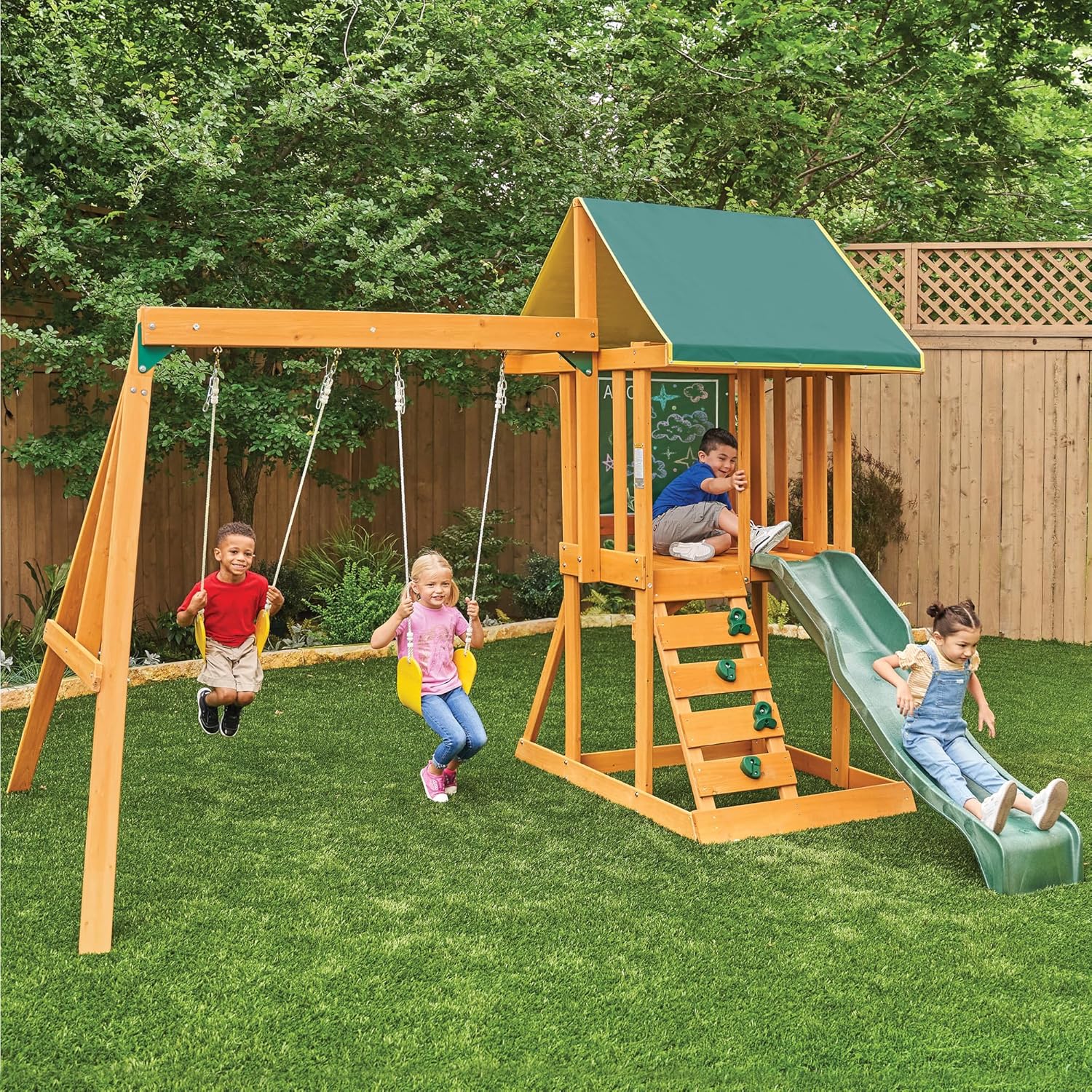
KidKraft
$429.99
In stock on Amazon
Check price on AmazonInstallation: The Hidden Cost Nobody Puts in the Ad
A swing set listed at $400 is not a $400 project. Here’s the math that buyers consistently under-estimate:
Typical total cost breakdown for a $200–$500 set:
| Line item | Estimated range |
|---|---|
| Set purchase price | $200–$500 |
| Ground anchoring hardware (if not included) | $25–$60 |
| Safety surfacing (rubber mulch or wood chips, 6-inch depth, 9×9 ft fall zone) | $80–$180 |
| Assembly tools / hardware upgrades | $20–$50 |
| Realistic total | $325–$790 |
The safety surfacing figure is the one that surprises people most. The CPSC recommends a minimum 6-inch depth of loose-fill material (wood chips, engineered wood fiber, or rubber mulch) under and around any home play structure, extending at least 6 feet in all directions from the equipment’s edge. Poured concrete, packed dirt, or grass don’t meet that standard. That’s not a scare tactic — it’s what makes the difference between a fall that bruises and a fall that fractures.
Most entry-tier sets also don’t include ground anchors, which keep the A-frame legs from “walking” across the yard during vigorous swinging. At this weight and size, anchor stakes are inexpensive ($25–$40 at most home improvement retailers), but they’re not optional if you have kids over 60 lbs or more than two kids swinging simultaneously.
Assembly time across owner reports runs 2–4 hours solo for a metal A-frame, 3–6 hours for a wood kit. If you’ve never assembled flatpack furniture, plan for the higher end.
Who Should Buy in This Tier — and Who Shouldn’t
Here’s the honest decision frame, stated plainly:
Buy in the $200–$500 tier if:
- Your kids are 3–8 years old and you expect to own the set 3–5 years before they age out of it
- You have one or two children (the weight and usage intensity of this hardware is not rated for family gatherings of 5–6 kids)
- You’re renting or plan to move within 5 years and want something you can leave behind or pass on without remorse
- Your yard is modest in size — these compact A-frames fit in spaces where a larger modular set wouldn’t
Stretch your budget above $500 if:
- You have kids at both ends of the 3–12 age range and need a set that grows with them (a dedicated toddler bay and a 10-year-old monkey bar challenge don’t coexist in this tier)
- You have three or more kids or frequent playdates with heavy simultaneous use
- You’re in a wet, freeze-thaw climate and want to avoid annual maintenance
- You’re buying for a daycare, school, or any commercial setting — the ASTM F1487 commercial standard is non-negotiable in those contexts, and nothing in this price range qualifies
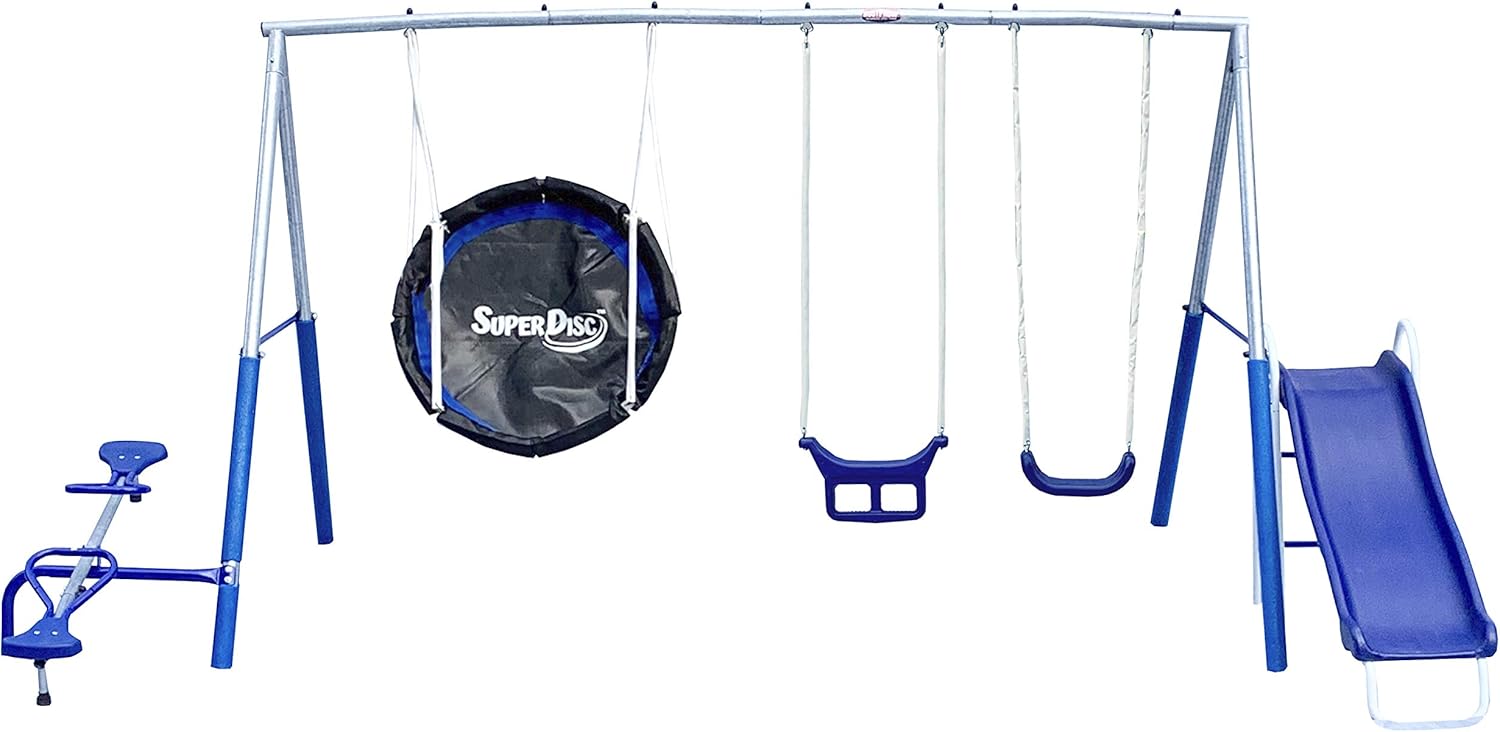
Free
$234.95
In stock on Amazon
Check price on AmazonHow to Evaluate a Specific Listing Before You Click Buy
You’ve found a candidate. Here’s the five-question checklist that separates a reasonable purchase from a regret:
- Does it list ASTM F1148 compliance? If not, ask. If no answer, move on.
- What’s the weight capacity per swing bay? Under 100 lbs is a red flag for anything other than a toddler-only setup.
- What wood or metal spec is used? Pressure-treated pine or powder-coated steel — anything else gets a hard look.
- Are ground anchors included or available as an add-on? Factor in the cost either way.
- What does the return window look like? Sets with no returns on assembled items are betting you won’t notice structural issues until it’s too late to act.
For mid-range sets that tick all five boxes, the value proposition is genuine. Owners consistently report satisfaction with entry-tier sets when the purchase is right-sized to the family’s actual usage — two kids, moderate use, three-to-five-year horizon.
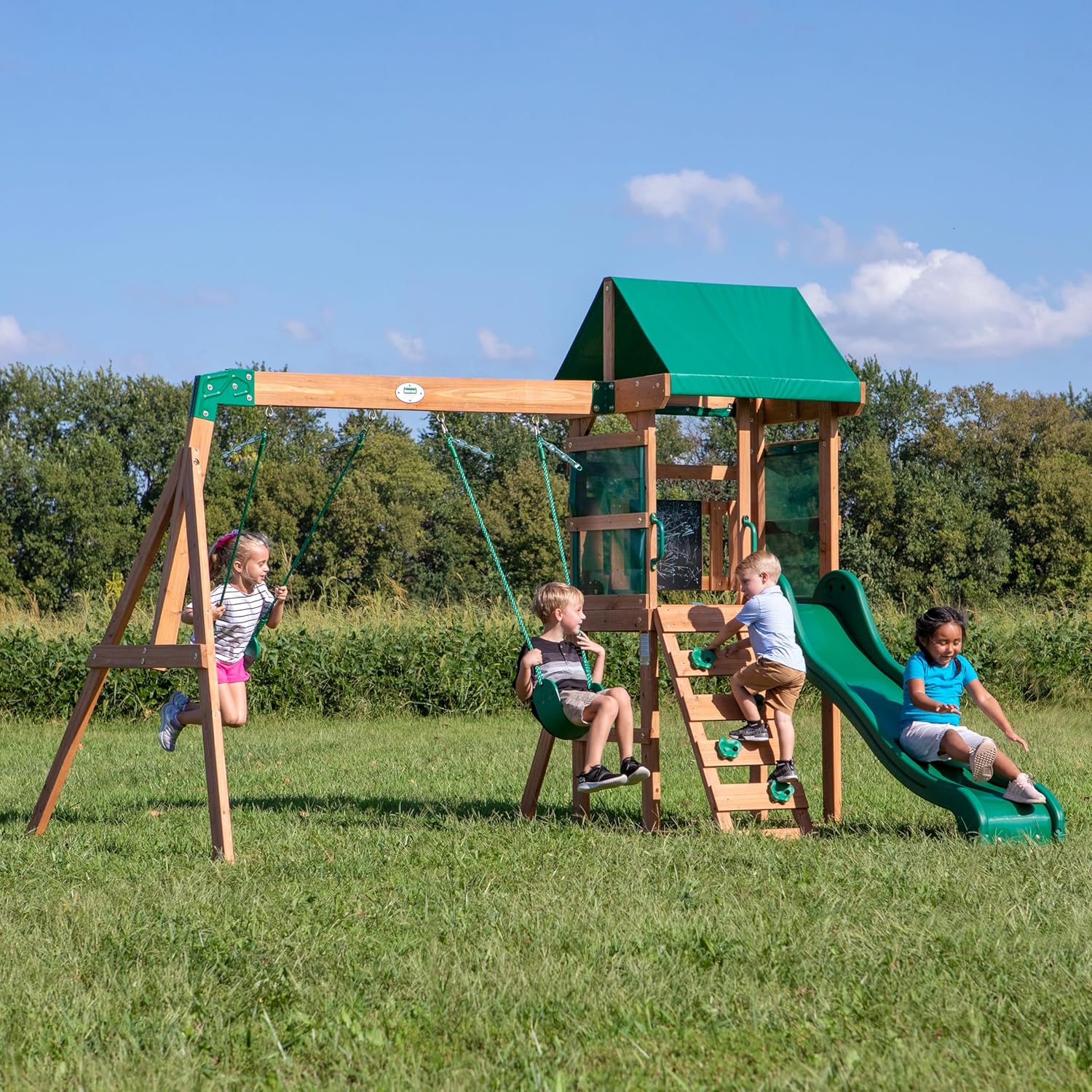
Backyard
$448.98
In stock on Amazon
Check price on AmazonFor families on the upper edge of this budget who want more attachment options (a glider swing, a trapeze bar) without crossing into the $600+ tier, there are sets in the $400–$500 range that offer modular add-on compatibility. Verify the add-on hardware is sold by the same manufacturer before assuming cross-brand compatibility — it rarely works.
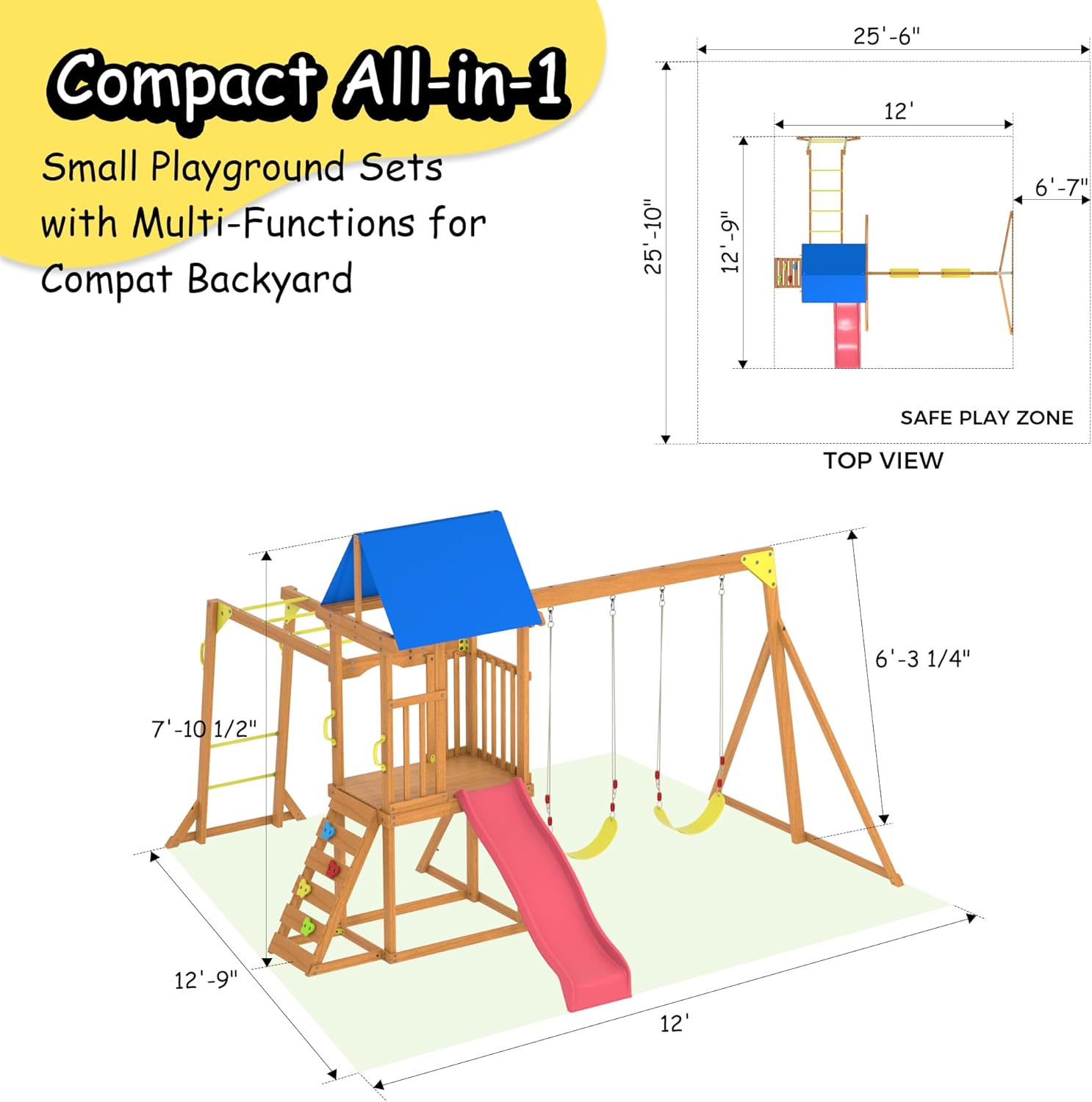
SUNIBOXI
$499.99
In stock on Amazon
Check price on AmazonThe Bottom Line
The $200–$500 swing set tier is real, functional, and right for a specific buyer — not a compromise everyone has to settle for. The key insight is sizing the purchase to the actual use case: young kids, modest use, medium-term horizon. Where buyers go wrong is buying this tier for situations that need the next one up: older kids, heavier use, longer ownership, or any commercial application.
Do the total-cost math including surfacing and anchoring before you compare sticker prices. Confirm ASTM F1148 compliance before you finalize. And inspect the set every spring for rust, rot, and loose hardware — the CPSC recommends it for a reason, and at this tier, the hardware is simply not built to a margin that forgives deferred maintenance.
If you check those boxes, there’s no reason to spend more than you need to.