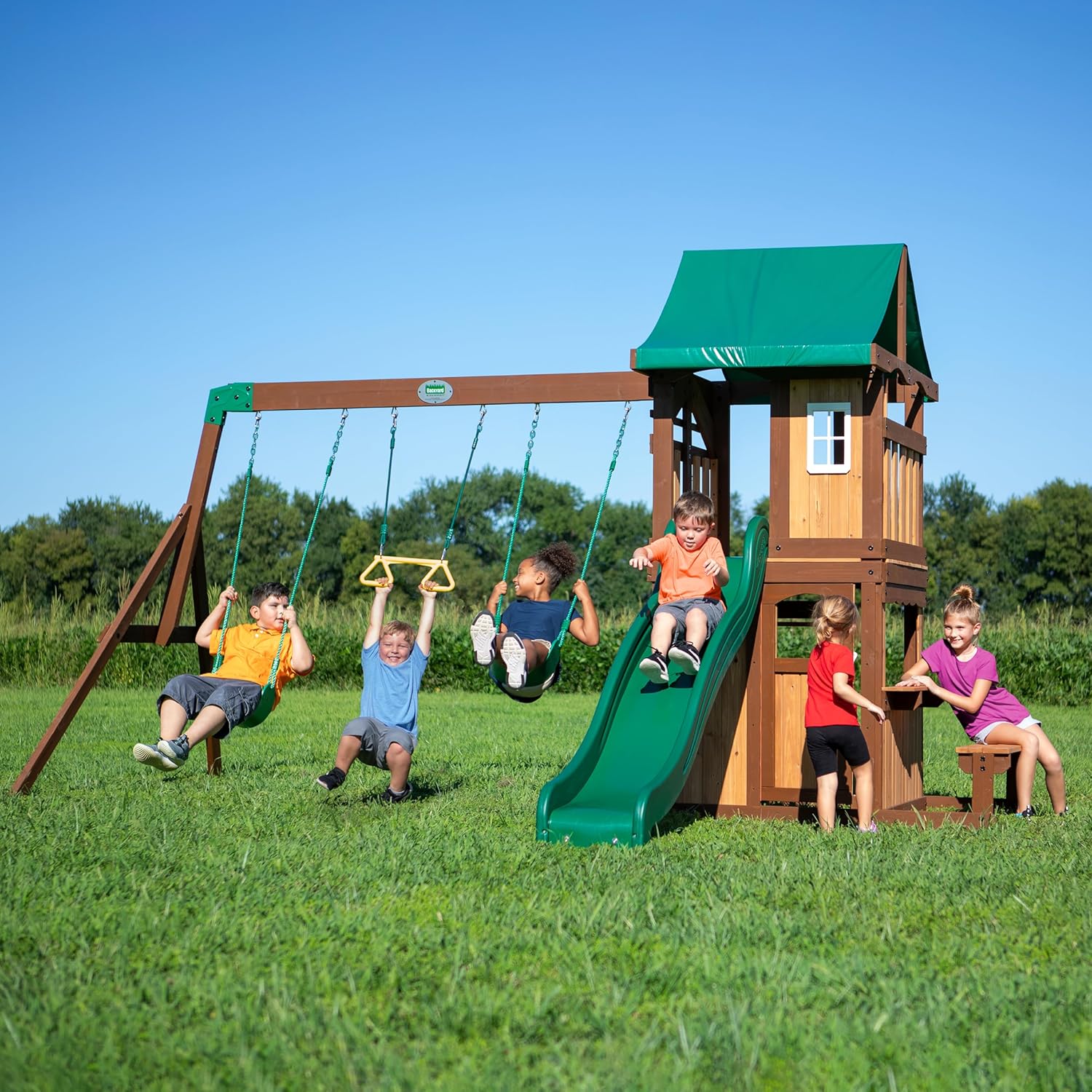
If you’ve been shopping swing sets for more than a few days, you’ve almost certainly landed on one of those gorgeous combo units — the kind with a two-story clubhouse (an enclosed or semi-enclosed elevated platform, basically a playhouse on stilts) bolted onto the same frame as the swings and slide. They photograph beautifully, they dominate backyard wish lists, and they carry a price tag that can stop a parent mid-scroll. A basic swing set — a metal A-frame with a couple of belt swings and a plastic slide — might run $300 to $600. Add a full clubhouse deck, a rock wall, a rope ladder, and a second slide, and you’re suddenly looking at $1,800 to $4,500 for a residential wood set, or considerably more for commercial-grade modular structures. This guide will help you figure out whether that premium is money well spent for your specific situation, or whether you’re paying for square footage your kids will ignore after Labor Day.
If you’ve already ruled out the basic swing set and you’re comparing combo configurations, welcome — the second half of this piece is where the real decision math lives.
What You’re Actually Buying When You Add a Clubhouse
Let’s be precise about what the “combo” category means, because it’s a wide tent. At the entry level, a playhouse-swing set combo might be little more than a small enclosed platform — say 4 feet by 4 feet — with a roof panel and a single steering wheel mounted to the railing. At the upper end, you get a multi-level structure with a true enclosed lower deck, an upper observation platform, a fabric or wood-panel roof, multiple access paths (slide, climbing wall, rope ladder, fireman’s pole), and three to five swing attachments. Same marketing language, very different product.
The core upgrade you’re paying for is usable enclosed square footage at height — a space kids can claim as their own, decorate mentally as a fort or rocket ship, and inhabit for extended imaginative play. Swing sets in the pure sense are about physical repetition: swing, slide, repeat. A combo with a real clubhouse adds what child development researchers call “affordance for dramatic play” — the structure invites a story, not just a movement.
Whether that affordance is worth the delta comes down to four variables: your children’s current ages, your site’s actual footprint, your material choice, and your honest view of how long you’ll own the structure.
By the numbers:
- Entry combo (enclosed platform, 1 slide, 3 swings): $800–$1,500 retail, ~55–80 sq ft footprint
- Mid-tier combo (2-level deck, 2 slides, climbing wall, 4+ swings): $1,800–$3,200 retail, ~120–160 sq ft footprint
- Premium residential wood combo (cedar, 2 levels, full roof, 5+ activities): $3,500–$5,500, ~180–250 sq ft footprint
- Required fall zone (per CPSC Publication 325): 6 feet beyond any equipment edge — adds ~400–600 sq ft to effective site demand
That fall-zone number is the one that catches buyers off guard most often. A structure that looks manageable on a product page can require a 30-foot by 35-foot cleared area once you add the mandatory 6-foot buffer on all sides. Penn State Extension’s guide on home playground equipment explicitly flags this as the most common residential installation error.
The Age-Range Fit Problem (and Why It Changes the ROI Calculation Entirely)
Here’s the trade-off no marketing page will name directly: the clubhouse component peaks in value between ages 4 and 8, while swings remain engaging from roughly 18 months through age 12. If your youngest child is currently 6 and your oldest is 9, the window for maximum clubhouse use is already narrowing. You might get two to three strong seasons before the structure becomes the thing they walk past on the way to a friend’s house.
Contrast that with a family where the youngest is 2 and there’s a sibling on the way. That same premium combo could earn eight to ten years of heavy use across multiple children — a very different cost-per-season picture.
ASTM Standard F1148, which governs consumer home playground equipment, sets design requirements by age band: equipment for children under 5 must meet different railing height and opening-size standards than equipment for ages 5–12. Many combo sets are designed primarily for the 5–12 range, which means a 3-year-old using the climbing wall or rope ladder is operating outside the structure’s tested design intent. This matters both for safety and for your realistic enjoyment timeline — a toddler-safe setup that grows with the family looks different from a “big kid” combo purchased when the youngest is already 7.
For families with a toddler still in the picture, a structured approach is worth considering:
 product image](/images/external/19f9eae542d7.jpg)
[Backyard](https://www.amazon.com/dp/B0C9KZSJS5?tag=greenflower20-20)
$2,198.98
In stock on Amazon
Check price on AmazonFor families squarely in the 5–9 sweet spot with multiple kids, a mid-tier combo is where the value density tends to concentrate:
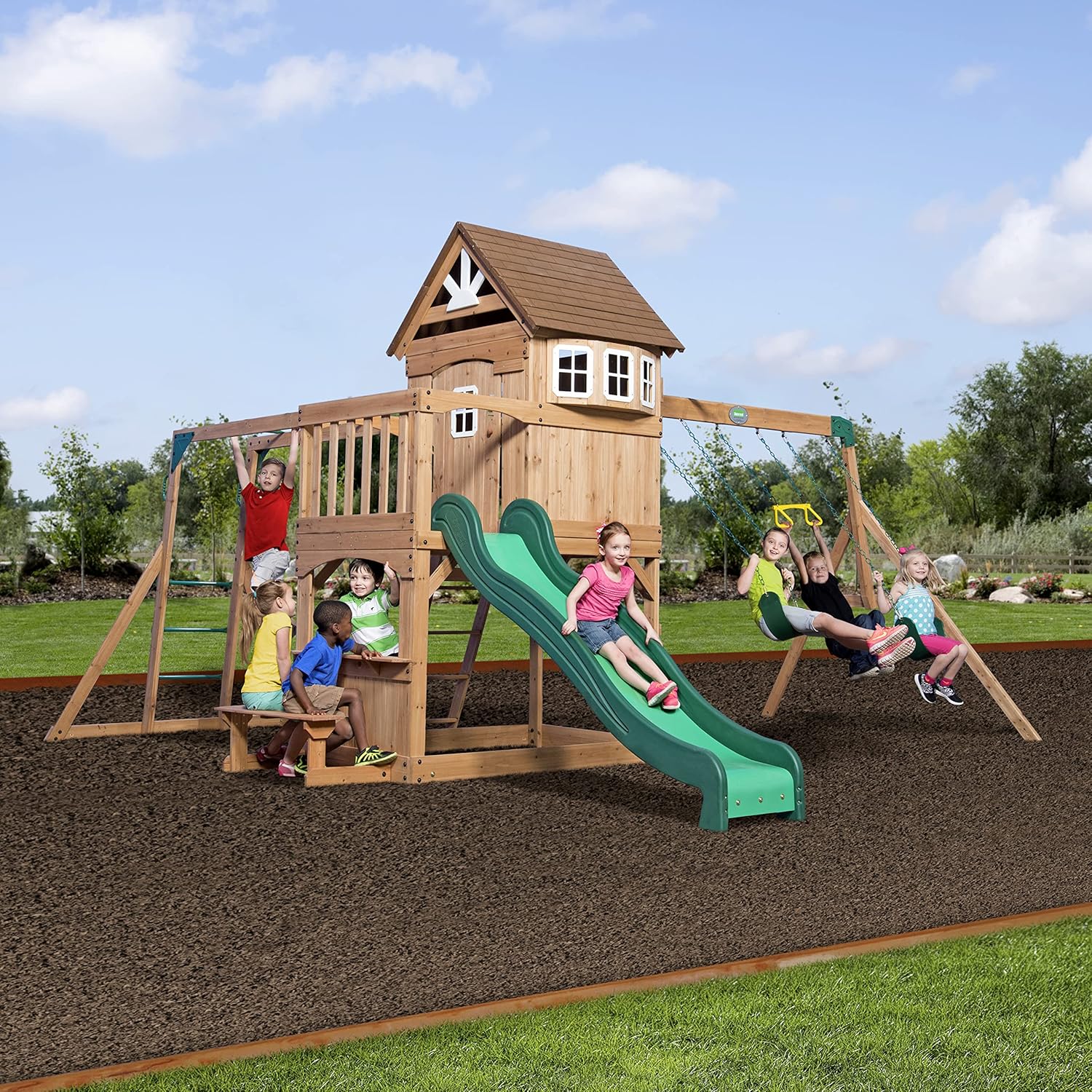
Backyard
$1,299.00
In stock on Amazon
Check price on AmazonMaterial Choice: Cedar vs. Vinyl vs. Metal — and How It Changes With the Clubhouse Addition
You’ve probably seen this comparison in other buying guides. The clubhouse component tips the scales in ways worth naming explicitly.
Cedar is the traditional choice for residential combo sets. It resists rot and insects without chemical treatment, it looks premium, and it’s what most premium brands build around. The trade-off: it requires annual or biennial sealing to maintain structural integrity. A pure swing set in cedar might forgive one missed maintenance season. A clubhouse adds roof panels, enclosed wall sections, and horizontal surfaces where water pools — all of which accelerate weathering if sealing lapses. Owners in aggregated review threads across major retailers consistently report that neglected cedar clubhouses show significant checking (surface cracking) and darkening within 24 to 36 months in humid climates.
Vinyl-clad or composite sets eliminate the sealing burden at the cost of aesthetics and, typically, configurability. The enclosed clubhouse components in vinyl sets tend to be more weatherproof but also more visually plasticky. If low-maintenance is genuinely your priority — not just a preference but a real constraint — this trade-off may be worth it.
Powder-coated steel is common in entry-to-mid residential combos and in commercial modular systems. The swing hardware on most wood sets is steel anyway; what changes in an all-metal combo is the platform and enclosure. Metal platforms transfer heat in direct sun (a legitimate burn risk on exposed surfaces, noted in the CPSC handbook), and they tend to feel less “fort-like” to children than wood. However, for commercial buyers — school districts, daycare operators, parks-and-rec departments — commercial-grade powder-coated steel is typically the material of choice because it meets ADA accessibility guidelines more readily and survives institutional use patterns that would shorten residential-rated wood structures significantly.
The NRPA’s maintenance management guidelines recommend that commercial operators plan for full component inspection at 1-, 3-, and 5-year intervals regardless of material — and that’s for equipment rated for commercial use. Residential combo sets used commercially (a common gray area at small daycares) often degrade faster than their warranty implies.
Backyard
$248.98
In stock on Amazon
Check price on AmazonBackyard
$2,198.98
In stock on Amazon
Check price on AmazonWhen the Clubhouse Upgrade Is Worth It: A Decision Framework
Let’s get concrete. Here’s how to think through the yes/no:
Go for the full combo if:
- Your youngest child is 2–5 and you have at least two kids who will use it. The clubhouse delivers peak value in the 4–8 window; starting at 3–4 means you’re buying into that window, not past it.
- Your yard can absorb the fall zone without sacrificing the rest of the outdoor space. Measure before you commit — use stakes and string to mock out the full footprint including the 6-foot buffer.
- You’re in cedar-friendly climate and willing to seal annually. The clubhouse’s weathered-wood aesthetic is part of its value; that aesthetic requires maintenance.
- You’re buying for a commercial or semi-commercial context (daycare, school) with a budget for commercial-rated equipment. In that case, skip residential combos entirely and look at IPEMA-certified modular systems — the certification means a third party has verified the manufacturer’s ASTM compliance claims, per IPEMA’s third-party certification overview.
Backyard
$248.98
In stock on Amazon
Check price on AmazonSkip the clubhouse and go simpler if:
- Your youngest is already 7 or older. You’ll spend the premium for two to three seasons of active clubhouse use before they age past it. A well-configured swing set with an attached slide and climbing wall delivers most of the physical engagement at 40–60% of the cost.
- Your yard is under 800 square feet total. The fall zone math is brutal in small lots; a compact swing set fits where a combo cannot.
- You’re replacing an existing structure and the new purchase overlaps with a teenager in the household who will age-gate younger siblings. The “cool” factor of the clubhouse evaporates fast once the 14-year-old won’t touch it.
- Your budget is firm under $1,200. Below that threshold, the combo options that exist are typically undersized, underbuilt, or both — you’re better served by a honest single-configuration set rated for the ages you’re actually buying for.
Backyard
$248.98
In stock on Amazon
Check price on AmazonFor buyers in the middle — two kids, ages 4 and 7, mid-sized yard, $1,500–$2,500 budget — the honest answer is that a mid-tier combo without the full second-story enclosure (an open upper platform with railing rather than a true clubhouse box) is often the best compromise. You get the elevation, the imaginative “up high” appeal, and the multi-activity configuration without the full price and footprint of the enclosed clubhouse. Owners in long-run reviews consistently report that open-deck combos hold engagement better into the 9–11 age range because older kids don’t feel the space is “baby-ish.”
Backyard
$2,198.98
In stock on Amazon
Check price on AmazonBefore You Finalize: The Checklist That Prevents Expensive Regrets
A few due-diligence items worth working through before you click purchase or sign the order form:
- Verify ASTM F1148 compliance (for residential) or F1487 compliance (for public/commercial use). These are the relevant ASTM standards; if a manufacturer can’t point you to their compliance documentation, that’s a signal.
- Check for IPEMA certification if you’re buying for a commercial context. IPEMA’s third-party verification is the fastest shortcut past manufacturer self-certification.
- Calculate your real total cost: set price + engineered wood fiber or rubber mulch surfacing (plan for 12 inches of depth, per CPSC guidelines, across your full fall zone) + installation labor if you’re not doing it yourself + annual sealing or maintenance budget for wood sets.
- Read the warranty’s fine print on the clubhouse components specifically. Roof panels and wall sections often carry shorter warranty terms than the structural frame — sometimes 1 year versus 5 or 10 years on the main posts.
- Check your HOA or municipality for permit requirements. Many jurisdictions require a building permit for permanent structures above a certain height or square footage; a two-story clubhouse combo often crosses that threshold where a basic swing set does not.
The clubhouse-combo premium is real, and so is the value — but only when the product meets the family it’s buying for. A well-matched combo set, installed correctly and maintained honestly, is one of the highest-engagement outdoor investments a family makes. An over-specified combo bought on wishful thinking about future kids or ignored age math is an expensive lawn ornament. The math isn’t complicated; it just requires you to be honest about where your family actually is right now, not where you hope it’ll be in three years.